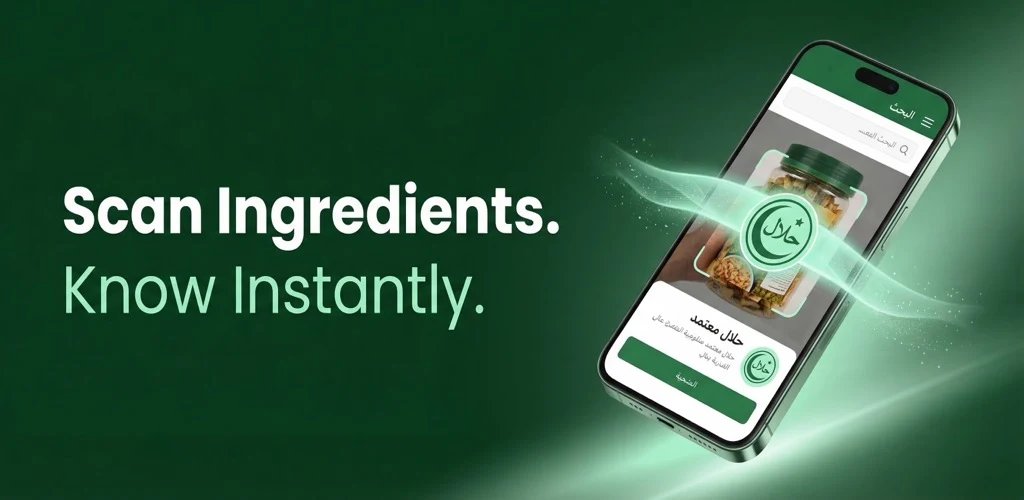
The Grocery Aisle Dilemma
Picture this: you're standing in a supermarket in Berlin, Toronto, or Seoul, holding a box of cookies. The packaging is in a language you don't fully read. There's no halal logo anywhere. The ingredient list mentions "emulsifier (E471)" and "natural flavoring" — and you have no idea whether either of those is derived from pork, alcohol, or something perfectly fine.
You pull out your phone and start Googling. Five minutes later, you're deep in a Reddit thread debating whether mono- and diglycerides of fatty acids are halal, and you still don't have a clear answer. The cookies go back on the shelf. You grab something you've bought before — something safe — and move on.
If you're one of the nearly 2 billion Muslims worldwide, this scenario probably feels familiar. The global halal food market is projected to reach over $2 trillion by 2026, yet for individual shoppers in non-Muslim-majority countries, finding halal food remains a daily exercise in patience, research, and sometimes just giving up.
That's where halal food scanner apps come in. These tools promise to take the guesswork out of grocery shopping — but not all of them work the same way, and the differences matter more than you'd think.
How Halal Food Scanner Apps Actually Work
Most halal food scanner apps fall into one of two categories: barcode-based scanners and AI ingredient analyzers. Understanding the difference is key to choosing the right tool.
Barcode-Based Scanning
Apps like Scan Halal and Halal Finder rely on barcode databases. You scan the product's UPC or EAN code, and the app looks it up in a pre-built database of products that have been manually reviewed and categorized as halal, haram, or mushbooh (doubtful).
The strength of this approach is precision — when a product is in the database, the result is typically reliable because a human reviewed it. The weakness is coverage. Barcode databases are built product by product, and they skew heavily toward products available in specific regions. If you're shopping at a local supermarket in South Korea or a specialty store in Germany, many products simply won't be in the database. You'll scan a barcode and get "product not found" — which is no help at all.
AI Ingredient Analysis
The newer generation of apps uses AI to analyze ingredient labels directly. Instead of depending on a barcode match, you point your camera at the ingredient list on the packaging, and the AI reads the text, identifies each ingredient, and cross-references it against a database of known halal, haram, and doubtful substances.
This approach has a major advantage: it works on any product with a readable ingredient list, regardless of whether the product exists in a barcode database. It's especially useful for imported goods, local brands, and products from smaller manufacturers that the big databases haven't catalogued yet.
Apps like Halal Lens, Halal Check, and Halal Identifier use this approach. Among these, Halal Lens takes an interesting angle — it's designed to work entirely offline with a built-in database of over 450 ingredients, which means you can use it even without an internet connection. That's a practical detail that matters when you're shopping in a basement-level grocery store with no signal, or traveling internationally without reliable data.
Hybrid Approaches
Some apps combine both methods. Mustakshif, for example, offers barcode scanning backed by a team of over 50 food analysts and scholars. HalalChecker AI uses AI-powered analysis along with crowdsourced data to keep results current. The idea is to give you multiple ways to check a product, so if one method doesn't return a result, the other might.
What to Actually Look for in a Halal Scanner App
After testing multiple apps and reading through hundreds of user reviews, we've found that the features that matter most aren't always the ones that get the biggest marketing push. Here's what actually makes a difference in daily use:
Ingredient-Level Detail
The best apps don't just give you a binary halal/haram verdict. They break down each ingredient and tell you why it's flagged. This matters because halal rulings can depend on sourcing — gelatin from beef processed according to Islamic guidelines is halal, while gelatin from pork is haram. An app that simply says "contains gelatin — haram" without context is less useful than one that says "contains gelatin — source unknown, classified as doubtful."
Offline Capability
This is an underrated feature. Most AI-powered apps require an internet connection to process scans, which means they're useless in areas with poor connectivity. If you travel frequently or shop in stores with weak signal, an app with a substantial offline ingredient database — like Halal Lens with its 450+ ingredients — gives you a safety net that cloud-dependent apps can't match.
Language Support
If you're shopping in a country where you don't read the local language fluently, the app needs to handle that language's ingredient terms. An app that only recognizes English ingredient names won't help much when you're staring at a product labeled in Arabic, Korean, or German. The better apps support multiple languages for both the interface and the ingredient recognition.
Free Access vs. Subscription Fatigue
Many halal scanner apps offer a limited free tier and then push you toward a subscription. There's nothing wrong with paid apps — developers need to eat too — but it's worth knowing what you get for free. Some apps like Halal Lens offer free daily scans, which is enough for regular grocery shopping without committing to a monthly payment. Others lock core features behind a paywall from day one.
The Real Pain Points These Apps Are Solving
To understand why halal food scanner apps have become so popular, it helps to look at the specific problems Muslim shoppers face, especially in non-Muslim-majority countries:
- Ingredient ambiguity — Terms like "natural flavoring," "E471," "lecithin," and "mono- and diglycerides" can be derived from either halal or haram sources. Without specialized knowledge, there's no way to tell from the label alone.
- No halal certification on most products — Halal certification is common on meat and some specialty products, but the vast majority of packaged foods in Western supermarkets carry no halal marking at all, even when the ingredients are perfectly halal.
- Information overload — Searching online for every questionable ingredient is time-consuming and often yields contradictory opinions. Different Islamic scholars and certification bodies sometimes disagree on borderline cases.
- Language barriers — Expats and international students often shop in countries where they can't read ingredient labels fluently, adding another layer of difficulty.
- Social pressure — Standing in a grocery aisle for 10 minutes Googling ingredients draws attention. A quick scan that takes a few seconds is much more practical and discreet.
A 2024 report from The Halal Times highlighted that limited access to clearly labeled halal products remains one of the top four challenges for Muslim consumers in non-Muslim countries, alongside affordability, skepticism from non-Muslim peers, and inconsistent labeling standards across regions.
Comparing the Top Halal Food Scanner Apps in 2026
Here's a practical comparison of the most popular halal food scanner apps available right now:
- Scan Halal — One of the oldest and most established apps. Barcode-based, with a large product database focused primarily on US and UK markets. Trusted by millions, but limited when products aren't in the database.
- Mustakshif — Barcode scanning backed by 50+ food analysts and Islamic scholars. Strong on verified product info and 24/7 support. Primarily barcode-dependent.
- Halal Check — AI-powered scanner that can analyze ingredient labels, barcodes, and even restaurant menus. Certified by the Global Islamic Food Council. Requires internet for AI features.
- Halal Identifier — AI-based label scanner that analyzes ingredients, E-numbers, and preparation methods. Clean interface with instant results.
- Halal Lens — AI ingredient label scanner that works without barcodes and without internet. Built-in database of 450+ ingredients with offline analysis. Supports English, Arabic, and Korean. Free daily scans on Android.
- HalalChecker AI — Combines AI scanning with crowdsourced data for up-to-date results. Good community features but relies on user contributions for accuracy.
- TagHalal — Focuses on identifying preservatives, colorants, and chemical additives. Users report a fast, large database, but interface is more technical.
Each of these apps has strengths in different scenarios. If you mostly shop at major US supermarkets and want maximum product coverage, a barcode-based app like Scan Halal makes sense. If you travel internationally, shop at local stores, or frequently encounter products without barcodes in the database, an AI ingredient scanner like Halal Lens or Halal Check is more practical.
5 Tips for Getting the Most Out of Your Halal Food Scanner
Whichever app you choose, these tips will improve your experience:
- Scan the ingredient list, not just the barcode. Even if a barcode scan returns "not found," you may get a result by scanning the ingredient label directly with an AI-based app.
- Check the "doubtful" items, don't just dismiss them. Mushbooh (doubtful) results deserve a closer look. The app might flag something because the source is unknown — not because it's definitively haram. Use the ingredient breakdown to make your own informed decision.
- Keep the app updated. Ingredient databases expand regularly. Running an outdated version means missing new ingredients that have been classified.
- Use offline mode when it's available. Download or cache the ingredient database before you go shopping. You don't want to be stuck with no results because the store has poor cell reception.
- Cross-reference when in doubt. No single app is perfect. For products you buy regularly, it's worth checking with two different apps or consulting an official halal certification body's website for a definitive answer.
The Bigger Picture: Technology as a Tool, Not a Fatwa
One important thing to keep in mind: halal food scanner apps are assistive tools, not religious authorities. They can identify known haram ingredients and flag doubtful ones, but they cannot verify the full production process — whether equipment was shared with non-halal products, whether the slaughter method was correct, or whether cross-contamination occurred during manufacturing.
For packaged goods with clear ingredient lists, these apps are genuinely useful. They save time, reduce anxiety, and help you make more informed decisions. But for meat products and anything where the production process matters as much as the ingredients, official halal certification from a recognized body remains the gold standard.
The good news is that the technology keeps getting better. AI models are becoming more accurate at reading labels in multiple languages, ingredient databases are growing, and community-driven verification adds another layer of reliability. For the nearly 2 billion Muslims navigating grocery aisles around the world, having a reliable scanner app in your pocket is no longer a luxury — it's becoming a practical necessity.
The best halal food scanner app isn't necessarily the one with the most features. It's the one that works reliably in your specific situation — your country, your grocery stores, your internet connectivity, and your language. Try a few, see which one fits your routine, and let the AI handle the ingredient research so you can get back to actually enjoying your food.