The Envelope Nobody Expected
You've been living in Germany for a few months. You found an apartment, signed the lease, and set up your Anmeldung. You're paying rent on time every month. Life feels under control. Then one day, a letter arrives from your landlord with a multi-page document covered in German legalese and a line at the bottom that says you owe an additional 400 euros. Welcome to the Nebenkostenabrechnung.
If this scenario sounds familiar, you're not alone. The annual utility bill settlement is one of the most confusing aspects of renting in Germany, especially for expats. The document is dense, the terminology is unfamiliar, and the stakes are real — we're talking about hundreds of euros that could either be owed to your landlord or refunded to you.
This guide breaks down everything you need to know: what the Nebenkostenabrechnung actually is, what costs it covers, how to check it for errors, and what your rights are as a tenant.
What Are Nebenkosten, Exactly?
In Germany, your monthly rent is typically split into two parts:
- Kaltmiete (cold rent) — the base rent for the apartment itself.
- Nebenkosten (additional costs) — the operating costs for the building, such as heating, water, waste collection, and building maintenance.
Together, these make up your Warmmiete (warm rent), which is what you actually pay each month. The Nebenkosten portion is an estimate. Your landlord sets a monthly prepayment amount (called Vorauszahlung) based on what they expect the actual costs to be. Once a year, they tally up what was really spent and compare it against what you prepaid. That reconciliation document is the Nebenkostenabrechnung — sometimes also called Betriebskostenabrechnung.
If you prepaid more than the actual costs, you get a refund (Guthaben). If you prepaid less, you owe a back payment (Nachzahlung). Either way, the landlord may also adjust your monthly prepayment going forward.
What Nebenkosten Typically Include
According to the German Operating Costs Regulation (Betriebskostenverordnung), the following costs can legally be passed on to tenants:
- Heating and hot water (Heizung und Warmwasser) — typically the largest line item, averaging around 1.32 EUR per square meter per month.
- Water and sewage (Wasser und Abwasser) — cold water supply and wastewater disposal.
- Property tax (Grundsteuer) — the municipal property tax allocated across all units.
- Waste collection (Muellabfuhr) — garbage pickup and recycling services.
- Building cleaning (Gebaeudereinigung) — cleaning of stairwells and common areas.
- Elevator (Aufzug) — maintenance and electricity for the elevator, if applicable.
- Building insurance (Gebaeudeversicherung) — fire, water damage, and liability insurance.
- Garden maintenance (Gartenpflege) — upkeep of shared outdoor areas.
- Caretaker services (Hauswart) — costs for a building caretaker or Hausmeister.
- Chimney sweep (Schornsteinfeger) — legally required inspections.
- Antenna and cable (Antenne/Kabel) — shared TV antenna or cable connection.
- Street cleaning and snow removal (Strassenreinigung und Winterdienst).
According to the Deutscher Mieterbund (German Tenants' Association), the average total Nebenkosten in Germany is approximately 2.67 EUR per square meter per month. For an 80 sqm apartment, that works out to roughly 2,565 EUR per year. When all possible operating cost items are included, the figure can reach up to 3.68 EUR per square meter per month.
What Cannot Be Charged to You
Equally important is knowing what your landlord is not allowed to include:
- Repairs and maintenance (Instandhaltung) — fixing broken pipes, replacing a boiler, repainting common areas.
- Administrative costs (Verwaltungskosten) — the landlord's time or fees for managing the property.
- Vacancy costs — if a unit in the building is empty, its share of costs cannot be shifted to other tenants.
- One-time investments — installing new equipment or upgrading infrastructure.
Your personal electricity is almost always separate — you sign your own contract with an energy provider (like Vattenfall, EnBW, or E.ON) and pay them directly.
The 12-Month Deadline Rule
German law (BGB § 556 Abs. 3) sets a strict deadline: the landlord must deliver the Nebenkostenabrechnung to the tenant within 12 months after the end of the billing period. For a billing year running January to December 2025, the statement must arrive by December 31, 2026.
This deadline is not negotiable. Here's why it matters:
- If the landlord misses the deadline: They lose the right to demand any Nachzahlung (back payment) from you. The claim simply expires. The only exception is if the landlord can prove the delay was not their fault (e.g., a utility company failed to provide data on time), which is rare.
- If you're owed a refund: The deadline protects the landlord, not you. Even if the statement arrives late, you can still claim your refund. The 12-month deadline only blocks additional charges — it doesn't eliminate credits.
- Your objection deadline: Once you receive the statement, you have 12 months to raise objections. This means if you get the statement in March 2026, you have until March 2027 to challenge it in writing.
Always check the date you received the letter. If it was mailed after the 12-month window, you may not owe anything — and if you already paid a late Nachzahlung, you may be entitled to reclaim it.
How to Spot Errors in Your Nebenkostenabrechnung
Here's a fact that might surprise you: according to the Deutscher Mieterbund, roughly every second Nebenkostenabrechnung contains errors. That's right — approximately half of all utility bill settlements in Germany have mistakes that are "too high, too late, or too imprecise." For expats who might not read the document carefully due to the language barrier, this is a real risk.
Here's a systematic checklist for reviewing your statement:
1. Check the Formal Requirements
A valid Nebenkostenabrechnung must include:
- The billing period (Abrechnungszeitraum) — typically 12 months.
- A list of total costs per category for the entire building.
- The distribution key (Verteilerschluessel) used to calculate your share — common methods include apartment size (sqm), number of people, or individual consumption.
- Your share of each cost item.
- The total of your prepayments and the resulting balance.
If any of these elements are missing, the statement may be formally invalid.
2. Compare with Previous Years
A sudden jump in costs — say, heating costs that doubled without an obvious reason — is a red flag. While energy prices do fluctuate, large unexplained increases deserve scrutiny. Keep your previous statements for comparison.
3. Verify the Distribution Key
The distribution key determines how building-wide costs are split among tenants. The most common method is by apartment size (square meters), but some costs, like water, might be distributed by number of occupants or actual consumption. Check that your apartment's size matches what's in your lease, and that the key used is consistent and fair.
For heating costs specifically, German law requires that at least 50% (and up to 70%) of heating costs be allocated based on individual consumption, not just apartment size. If your heating bill is calculated entirely by square meters, that's likely an error.
4. Look for Non-Allocable Costs
Scan the line items for costs that shouldn't be there: repair work disguised as maintenance, the landlord's property management fees, costs for amenities that don't exist in your building (like an elevator charge when there is no elevator), or bank fees.
5. Request Supporting Documents
You have the legal right to inspect the original invoices, contracts, and receipts that back up the statement. This is called Belegeinsicht. You can ask to view these at your landlord's office or request copies. If the landlord refuses, the charges become unproven and a court will likely invalidate them.
What to Do If You Disagree
If you find errors or have concerns about your Nebenkostenabrechnung, here's the recommended process:
- Pay first, dispute later. German courts have ruled that tenants should pay the Nachzahlung by the due date, even if they plan to challenge it. You can recover the amount later if your objection is successful. Refusing to pay can lead to complications.
- Write a formal objection (Widerspruch). Do this in writing — email can work, but a registered letter (Einschreiben) gives you proof of delivery. State the specific items you're disputing and why.
- Request Belegeinsicht. Ask to see the underlying invoices. This often reveals whether a charge is legitimate.
- Contact a Mieterverein. Germany's tenant associations (Mieterverein) offer professional review of your Nebenkostenabrechnung, typically as part of a membership that costs 60 to 100 EUR per year. They catch errors that non-experts easily miss.
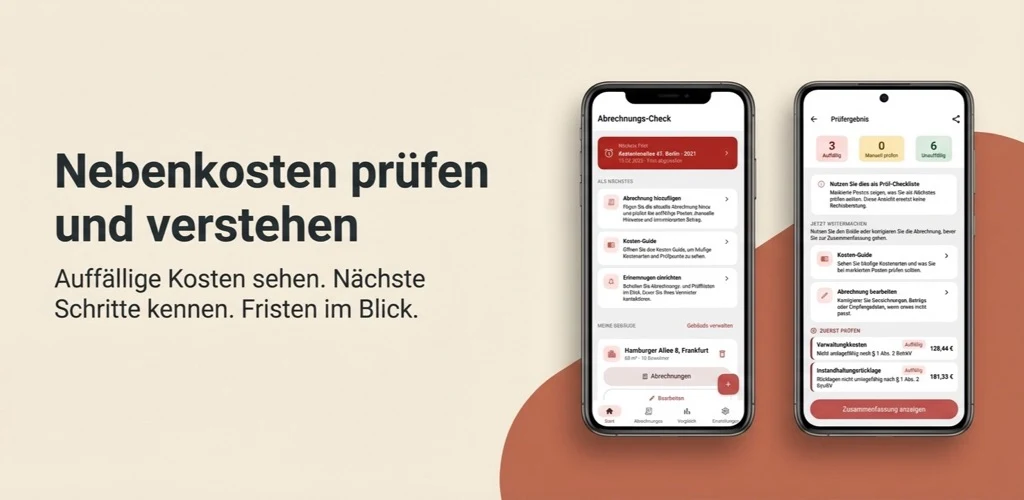
- Use digital tools. Apps like NeiboCheck can help you analyze your Nebenkostenabrechnung line by line, flagging unusual costs and making sure you don't miss important deadlines. This is especially useful for expats who may not be familiar with what's normal and what's not in a German utility bill.
Remember: you have 12 months from receipt of the statement to lodge your objection. Don't sit on it — the sooner you start reviewing, the more time you have to gather information.
Practical Tips for Expats Dealing with Nebenkosten
Based on everything we've covered, here are concrete steps to stay on top of your utility costs in Germany:
- Understand your lease. Before signing, check what's included in your Nebenkosten prepayment and what you pay separately. Ask your landlord to explain the estimated breakdown if you're unsure.
- Save every statement. Keep a digital or paper copy of each Nebenkostenabrechnung. Comparing year over year is the easiest way to catch anomalies.
- Note the delivery date. When you receive the statement, write down the date. This starts your 12-month objection clock and helps you verify whether the landlord met their deadline.
- Learn the key German terms. You don't need to be fluent, but knowing terms like Nachzahlung (back payment), Guthaben (credit), Vorauszahlung (prepayment), and Verteilerschluessel (distribution key) will help you navigate the document.
- Budget for Nachzahlung. It's common to owe an additional payment, especially after your first year. Setting aside 50 to 100 EUR per month beyond your Warmmiete gives you a buffer.
- Don't ignore it. The worst thing you can do is toss the statement in a drawer because it's in German and looks complicated. Every year, tenants lose hundreds of euros simply because they didn't review their bill. With tools like NeiboCheck available to walk you through each line item, there's no reason to leave money on the table.
Final Thoughts
The Nebenkostenabrechnung is one of those uniquely German experiences that catches almost every expat off guard. It's complex, it's in dense legal German, and it involves real money. But once you understand the structure — what can be charged, what the deadlines are, and how to check for errors — it becomes far less intimidating.
The key takeaway: always review your statement. With roughly half of all Nebenkostenabrechnungen containing errors according to tenant association data, the odds are genuinely in favor of finding something worth questioning. Whether you do it yourself, join a Mieterverein, or use an app to help you parse the details, taking 30 minutes to review your bill could save you hundreds of euros.
Your landlord is required to be transparent. You have the right to see the receipts, challenge the math, and get your money back if you were overcharged. Don't let the language barrier stop you from exercising those rights.