The Silent Struggle at the Supermarket
Moving to a non-Muslim country is exciting until you need to buy groceries. Suddenly, the simple act of picking up a loaf of bread becomes a research project. You flip over packages, squint at ingredient lists written in unfamiliar languages, and Google chemical-sounding names you've never seen before. After twenty minutes of this, you leave the store with half the items on your list and twice the frustration you walked in with.
If this sounds like your weekly routine, you're not alone. With nearly 2 billion Muslims worldwide and growing diaspora communities across Europe, North America, East Asia, and beyond, halal grocery shopping in non-Muslim countries is a shared challenge that rarely gets talked about in practical terms. Most advice online is either too vague ("just look for the halal logo") or too scholarly (fatwa-level discussions about E-numbers) to be useful when you're standing in a supermarket aisle with a shopping cart and thirty minutes to spare.
This guide is different. We'll walk through real, actionable tips — from decoding ingredient labels to leveraging technology — so you can shop faster, smarter, and with genuine peace of mind.
Why Halal Shopping Is Harder Than It Should Be
Before jumping into tips, it helps to understand why halal grocery shopping is so difficult in non-Muslim countries. It's not just about the absence of halal logos.
The Certification Gap
Halal certification is common on meat, poultry, and some specialty imported products. But the vast majority of packaged foods — bread, snacks, sauces, dairy, frozen meals — carry no halal marking at all, even when their ingredients are perfectly permissible. Manufacturers in non-Muslim-majority countries simply don't see the business case for getting every product certified, especially when certification costs can be significant and the process varies across the more than 400 halal certification bodies worldwide.
This means you can't rely on the presence or absence of a halal logo alone. A product without a logo might be completely halal, and occasionally, a product marketed as "natural" or "organic" might contain ingredients derived from non-halal sources.
Language Barriers
If you're shopping in Germany, South Korea, Japan, or any country where you don't read the local language fluently, ingredient lists become nearly impenetrable. Even if you know the English names of problematic ingredients, you might not recognize them in German (Schweineschmalz = pork lard), Korean (돈지 = pork fat), or Japanese (豚由来 = pork-derived). This language gap is one of the biggest practical obstacles Muslim expats face.
The Ingredient Complexity Problem
Modern processed food uses hundreds of additives, emulsifiers, stabilizers, and flavorings — many of which have ambiguous origins. An ingredient can be derived from plant, animal, or synthetic sources, and the label rarely tells you which. This ambiguity is the core of the problem, and it's why simply memorizing a short list of "bad ingredients" isn't enough.
The Hidden Haram Ingredients You Need to Know
Let's get specific. These are the ingredients that trip up even experienced halal-conscious shoppers, because they don't obviously sound haram but frequently are.
Gelatin (E441)
The most well-known hidden ingredient. Gelatin is a protein derived from animal collagen — most commonly from pork skin and bones. It appears in gummy candies, marshmallows, some yogurts, frosted cereals, gel capsule vitamins, and even certain cream cheeses. In Europe, if a product simply says "gelatin" without specifying "beef gelatin" or "fish gelatin," it's almost certainly pork-derived.
What to do: Look for products that specifically state "beef gelatin" or "fish gelatin," or choose alternatives made with pectin or agar-agar.
E471 — Mono- and Diglycerides of Fatty Acids
This is perhaps the most frustrating ingredient on any halal shopper's list. E471 is an emulsifier found in an astonishing range of products: bread, margarine, ice cream, chocolate, baked goods, and ready meals. It can be derived from plant oils or animal fats — and the label almost never tells you which. In practice, many manufacturers source E471 from the cheapest available fat, which often means animal-derived.
What to do: If the product has a vegan label or explicitly states "plant-derived emulsifiers," it's safe. Otherwise, treat E471 as doubtful unless you can verify the source with the manufacturer.
L-Cysteine (E920)
An amino acid used as a dough conditioner in commercial bread, pizza dough, and baked goods. The unsettling part: L-cysteine is often derived from human hair, pig bristles, or duck feathers. While synthetic and plant-based versions exist, the source is rarely disclosed on labels.
What to do: Choose bread from bakeries that disclose their ingredients fully, or look for brands that specifically market their products as halal or vegan.
Carmine (E120 / Cochineal)
A bright red food dye made from crushed cochineal insects. Found in red or pink candies, fruit juices, yogurts, and even some sauces. While some scholars permit insect-derived ingredients, many consider carmine haram. It's worth being aware of it and making your own informed decision.
What to do: Check the label of any red-colored food or drink. Alternative red colorings include beetroot extract and paprika extract.
Rennet in Cheese
Most cheese is made with rennet — an enzyme traditionally extracted from the stomach lining of calves. If the animal wasn't slaughtered according to Islamic guidelines, the cheese is considered haram by many scholars. Additionally, some rennet is derived from pork.
What to do: Look for cheese made with "microbial rennet," "vegetable rennet," or "vegetarian enzymes." Many European cheeses like traditional Parmesan (Parmigiano-Reggiano) always use animal rennet, so be cautious.
Alcohol in Everyday Foods
Alcohol appears in more products than you'd expect: vanilla extract, some chocolates, tiramisu, certain soy sauces, wine vinegar, and many sauces and marinades. While cooking may evaporate some alcohol, the permissibility of residual alcohol in food is debated among scholars.
What to do: Choose alcohol-free vanilla flavoring, check soy sauce labels (naturally brewed soy sauce contains trace alcohol from fermentation), and be mindful of desserts and sauces in Western cuisine.
Other Ingredients to Watch
- Whey powder — Can be processed with animal-derived enzymes
- "Natural flavoring" — A catch-all term that could include animal-derived substances
- Lecithin (E322) — Usually soy-based, but can occasionally be animal-derived
- Pepsin — A digestive enzyme almost always derived from pork
- Stearic acid (E570) — Can be plant or animal-derived
- Glycerin / Glycerol (E422) — Often from animal fats in non-halal products
How to Read Food Labels Like a Pro
Knowing the problematic ingredients is only half the battle. You also need a systematic approach to reading labels efficiently, especially when you're in a hurry.
The Three-Pass Method
Instead of reading every ingredient on every product, use this quick triage system:
Pass 1 — Look for certifications. Check for halal certification logos, vegan logos (vegan products are almost always halal from an ingredient standpoint, though not a substitute for halal meat), or kosher symbols (many kosher rules overlap with halal, though they're not identical).
Pass 2 — Scan for red flags. Quickly scan the ingredient list for the high-risk items: gelatin, E471, animal fat, lard, rennet, carmine, L-cysteine, and alcohol. If none are present, the product is likely fine.
Pass 3 — Check ambiguous items. If you spot something unfamiliar — an E-number you don't recognize or a term you can't translate — this is where technology becomes your best friend.
Let Technology Do the Heavy Lifting
You don't have to memorize every E-number or carry a printed list of haram ingredients. AI-powered tools can analyze ingredient labels instantly and tell you whether each ingredient is halal, haram, or doubtful.
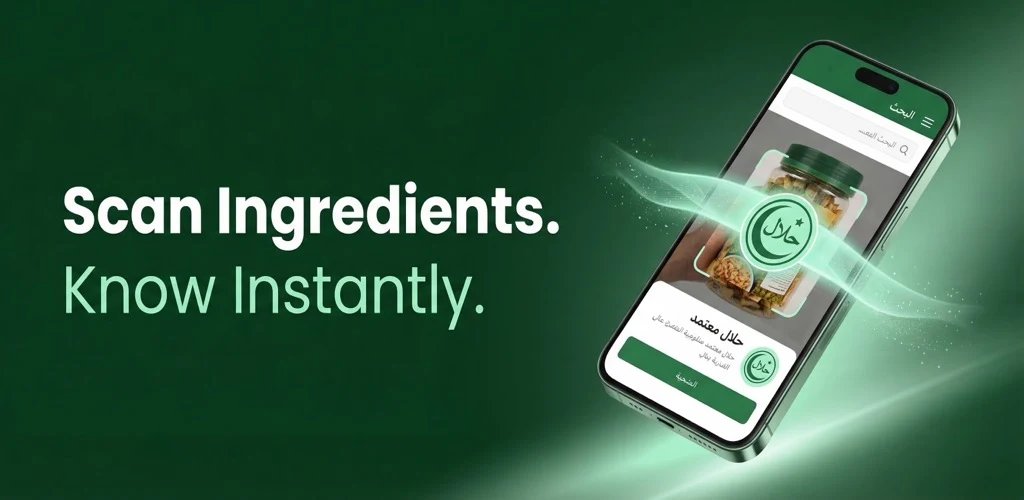
Halal Lens is one such tool that takes a practical approach to this problem. Instead of relying on barcode databases (which fail when a product isn't in the database), it uses AI to read the ingredient label directly from your phone's camera. Point it at the ingredient list, and it identifies each component and flags anything that's haram or doubtful. It works in English, Arabic, and Korean, and — importantly — it works offline with a built-in database of over 450 ingredients. That last part matters when you're shopping in a basement-level mart with no cell reception.
The key advantage of AI ingredient scanning over barcode scanning is universality. It works on any product with a readable ingredient list, whether it's a local brand in Seoul, a specialty item in a German organic store, or an imported snack from a Middle Eastern shop. No barcode needed.
The Vegan Label Shortcut
Here's a practical hack that many Muslim shoppers discover over time: vegan-certified products are almost always halal from an ingredient perspective. If a product carries a recognized vegan certification (like the V-Label or Vegan Society trademark), it means no animal-derived ingredients were used — which eliminates most halal concerns for packaged foods.
This doesn't apply to meat (you still need properly slaughtered halal meat), and it doesn't address the alcohol question. But for snacks, baked goods, sauces, and other packaged items, the vegan label is a remarkably reliable shortcut.
Finding Halal Grocery Stores and Products
Beyond reading labels, knowing where to shop can save you enormous time and effort.
Ethnic and Specialty Grocery Stores
In most major cities in non-Muslim countries, you'll find Middle Eastern, Turkish, South Asian, or African grocery stores that stock a wide range of halal products — from fresh halal meat to imported snacks and spices you can trust. These stores are often the backbone of halal shopping for Muslim communities abroad.
How to find them: Google Maps searches for "halal grocery," "Middle Eastern market," or "Turkish supermarket" in your area usually turn up results. In cities like Berlin, London, Toronto, and Seoul, there are well-established halal shopping districts. Community Facebook groups and WhatsApp groups for local Muslim expats are also goldmines for store recommendations.
Navigating Mainstream Supermarkets
You'll inevitably shop at mainstream supermarkets too. Here's how to make it work:
- Produce section: Fresh fruits, vegetables, grains, legumes, nuts, and seeds are inherently halal. Build your meals around these and you'll have fewer packaged products to worry about.
- Frozen section: Be cautious. Frozen meals, pizza, and ready-to-eat items frequently contain hidden animal-derived ingredients. Always check the label.
- Dairy section: Milk, butter, and plain yogurt are generally safe. Be careful with flavored yogurts (may contain gelatin), cheese (rennet concerns), and cream-based products.
- Bakery section: Bread can contain L-cysteine or animal-derived emulsifiers. In-store bakery products are often safer because they tend to use simpler recipes with fewer additives.
- International aisle: Many supermarkets now have an "international" or "world foods" section that includes halal-labeled products. This section has grown significantly in recent years.
Online Halal Shopping
E-commerce has been a game-changer for halal shopping. Online halal grocery stores ship halal meat, snacks, and specialty items directly to your door. This is especially valuable if you live in a smaller city or rural area without local halal shops.
Search for "halal grocery delivery" plus your country or city name. Many services now offer subscription boxes of halal snacks and pantry staples, which can simplify your routine considerably.
Country-Specific Shopping Tips
Halal shopping challenges vary significantly by country. Here are some practical notes for popular destinations:
Europe (Germany, UK, France, Netherlands)
Europe generally has good halal infrastructure in major cities, thanks to large Turkish and North African communities. In Germany, Turkish supermarkets (like those in areas with significant Turkish populations) are excellent sources for halal groceries. The UK has perhaps the best halal product availability of any non-Muslim Western country, with major supermarket chains like Tesco and Sainsbury's stocking halal-certified products in many locations.
Watch out for: E471 in bread and baked goods is very common across Europe. Pork-derived gelatin is the default in most European confectionery.
East Asia (South Korea, Japan)
Halal shopping in East Asia presents unique challenges. Halal certification is less common, ingredient labels may be entirely in Korean or Japanese, and pork-derived ingredients are deeply embedded in the local food culture. In South Korea, look for international grocery stores in Itaewon (Seoul) or near university areas. In Japan, halal-friendly stores have been growing, particularly in areas like Shin-Okubo in Tokyo.
Watch out for: Many Korean and Japanese sauces, broths, and seasonings contain pork extract or alcohol. Even seemingly simple products like rice crackers may contain animal-derived seasonings.
North America (USA, Canada)
The US and Canada have a growing halal retail presence, especially in cities with large Muslim populations (Dearborn, New York, Toronto). Major retailers are increasingly adding halal-certified items to their shelves. Costco, Walmart, and Whole Foods have all expanded their halal offerings in recent years.
Watch out for: "Natural flavoring" is an extremely common label term in US food products and can include animal-derived substances. Always verify.
Building a Halal Shopping Routine
The most effective strategy isn't about being perfect on every shopping trip — it's about building a sustainable routine that reduces stress over time.
Create Your Personal "Safe List"
Every time you verify that a product is halal — whether by checking the label, scanning it with an app like Halal Lens, or contacting the manufacturer — add it to a running list on your phone. Over time, you'll build a personal database of trusted products at your regular stores. This means fewer items to check on each trip and faster, more relaxed shopping experiences.
Batch Your Research
Instead of researching ingredients in the store (where you're rushed and the internet might be spotty), do your research at home. Look up the products you're curious about, check their ingredients online, scan labels with an app, and make your decisions in advance. Then your actual shopping trip becomes a simple pickup run.
Connect with Your Local Muslim Community
Other Muslim families in your area have already solved many of the same problems you're facing. Local mosque communities, Muslim student associations, and expat groups on social media are invaluable resources for product recommendations, store tips, and even shared grocery runs.
Cook from Scratch When Possible
The simplest way to ensure your food is halal is to cook from whole, unprocessed ingredients. Fresh produce, grains, legumes, and properly sourced halal meat are all straightforward. The more you cook from scratch, the fewer packaged products you need to scrutinize. This isn't always practical for busy schedules, but even shifting a few meals per week toward home-cooked food can significantly reduce the label-reading burden.
Technology as Your Everyday Ally
We've mentioned AI-powered tools a few times, and it's worth emphasizing how much they've changed the halal shopping experience in the last couple of years.
The old approach was to carry a printed list of haram E-numbers, manually cross-reference each ingredient, and hope you didn't miss anything. The new approach is to point your phone camera at an ingredient label and get an instant analysis of every component — flagged as halal, haram, or mushbooh (doubtful) — in seconds.
Tools like Halal Lens have made this particularly accessible. Because it works offline with a built-in ingredient database and supports multiple languages including English, Arabic, and Korean, it addresses three of the biggest pain points at once: no internet dependency, no barcode dependency, and no language barrier. You can scan a product label in a Korean supermarket or a German discount store and get results immediately, even without knowing the local language.
That said, no app replaces Islamic scholarship. These tools analyze ingredients, not production processes. For meat, dairy with animal enzymes, and products where cross-contamination is a concern, official halal certification from a recognized body remains the gold standard. Use technology as a complement to — not a replacement for — your own judgment and trusted certification.
Final Thoughts: Shopping with Confidence
Halal grocery shopping in a non-Muslim country doesn't have to be a stressful ordeal. Yes, it requires more awareness than shopping in a Muslim-majority country. But with a systematic approach — knowing your high-risk ingredients, using the vegan label shortcut, building a personal safe list, leveraging AI tools, and connecting with your community — it becomes manageable and even routine.
The global halal food market is projected to exceed $2 trillion by 2026, and retailers worldwide are taking notice. Halal product availability is improving year by year, online options are expanding, and technology is closing the information gap faster than ever before.
Start with the basics: learn the key ingredients to avoid, download a reliable scanning tool, find your local halal-friendly stores, and build your safe list product by product. Before long, you'll navigate any supermarket aisle with confidence — no matter what country you're in.
May your grocery runs be swift and your ingredient lists be clear. Happy shopping.