The Writing Score Anxiety Every IELTS Candidate Knows
You have spent weeks — maybe months — preparing for IELTS. You can handle Reading passages. Listening feels manageable. Speaking is nerve-wracking but survivable. And then there is Writing. You stare at the Task 2 prompt, write 250+ words that feel decent, and submit your paper with absolutely no idea whether you just wrote a Band 5.5 essay or a Band 7. That uncertainty is what makes IELTS Writing uniquely stressful.
Here is the uncomfortable truth backed by data: Writing is consistently the lowest-scoring section on the IELTS exam worldwide. According to official IELTS test statistics, the global mean Writing score for Academic test-takers hovers around 5.5 to 6.0, while Listening and Reading averages sit noticeably higher. In countries like Turkey, South Korea, and Iran, Writing scores tend to lag behind other sections by 0.5 to 1.0 bands on average.
For the millions of students who need a 6.5 or 7.0 to get into their target university or qualify for immigration, that gap between their current Writing score and their goal feels enormous. And the traditional way to close it — paying for private tutors who charge $50-100 per essay evaluation — is slow, expensive, and often inconsistent. This is exactly where AI-powered IELTS writing scorers are changing the game.
Why Writing Is the Hardest IELTS Section (and It Is Not Just You)
Before we talk about solutions, it helps to understand why Writing trips up so many test-takers. Unlike Reading and Listening, where there is a clearly correct answer, Writing is evaluated across four subjective criteria — and you need to perform well on all of them simultaneously.
The Four Scoring Criteria, Explained Simply
1. Task Response (TR) / Task Achievement (TA) — Did you actually answer the question? This sounds basic, but it is the most common reason for low scores. Many candidates write a well-structured essay that only partially addresses the prompt. If the question asks you to discuss both advantages and disadvantages, writing only about advantages will cap your TR score regardless of how good your English is.
2. Coherence and Cohesion (CC) — Does your essay flow logically? Are your paragraphs organized around clear central ideas? Do you use linking words naturally, or are you stuffing in "Furthermore" and "Moreover" every other sentence? Examiners can tell the difference between genuine coherence and mechanical connector usage.
3. Lexical Resource (LR) — This is your vocabulary range and accuracy. Using "good" five times will score lower than appropriately using "beneficial," "advantageous," "favorable," and "constructive." But be careful: using complex vocabulary incorrectly actually hurts your score more than using simple words correctly.
4. Grammatical Range and Accuracy (GRA) — Can you write complex sentences without making errors? The key word here is range. Writing only simple sentences (Subject + Verb + Object) will limit your score even if every sentence is grammatically perfect. Examiners want to see a mix of simple, compound, and complex structures.
Each criterion accounts for 25% of your Writing band score. The challenge is that improving one area often creates problems in another. When candidates try to use more advanced vocabulary (LR), they tend to make more grammatical errors (GRA). When they focus on complex sentence structures, their coherence sometimes suffers. It is a balancing act, and without detailed feedback on each criterion, it is nearly impossible to know where you actually stand.
The Most Common Mistakes That Kill Your Writing Score
After analyzing thousands of IELTS essays, researchers and examiners have identified recurring patterns that keep scores stuck in the 5.0-6.0 range. Here are the ones that matter most:
Not Fully Answering the Question
This is the number one score killer. IELTS Task 2 prompts often have multiple parts: "To what extent do you agree or disagree?" requires a clear position. "Discuss both views and give your opinion" requires coverage of both sides plus your own stance. Missing any part of the prompt automatically limits your Task Response score to Band 5 or below, no matter how eloquent your writing is.
The Memorized Phrases Syndrome
Examiners are trained to spot memorized templates. Phrases like "In today's modern world" or "It is an undeniable fact that" are red flags. They signal that you are padding your essay with filler rather than engaging with the actual topic. This directly impacts both your Coherence and Lexical Resource scores.
Word Count Mismanagement
Task 1 requires a minimum of 150 words; Task 2 requires 250. Writing fewer words results in an automatic penalty. But the opposite problem is just as dangerous: writing 400+ words for Task 2 usually means you are being repetitive, running out of time to proofread, and making more errors in the rush to finish. The sweet spot is 260-290 words for Task 2, written carefully with time left for review.
Persistent Tense and Article Errors
For speakers of Turkish, Korean, Japanese, and many other languages, English articles ("a," "the") and tense consistency are particularly difficult. Korean, for example, does not use articles at all, and Turkish article usage follows different logic. These small errors accumulate throughout an essay and can drop your GRA score by a full band.
Underestimating Task 1
Many candidates pour all their preparation into Task 2 and neglect Task 1 (graph/chart/diagram description). But Task 1 counts for one-third of your Writing score. A weak Task 1 performance can drag down your overall band even if your Task 2 is solid. Learning to describe trends, compare data, and summarize visual information is a distinct skill that requires separate practice.
How AI Writing Scorers Are Changing IELTS Preparation
Traditionally, the only way to get meaningful feedback on your IELTS Writing was to pay a tutor or take a prep course. You would write an essay, submit it, wait days for feedback, and get comments that might or might not align with the actual IELTS scoring rubric. The feedback loop was slow, expensive, and limited.
AI-powered IELTS writing scorers compress that feedback loop from days to seconds. Here is what the best tools offer:
Instant Band Score Estimates
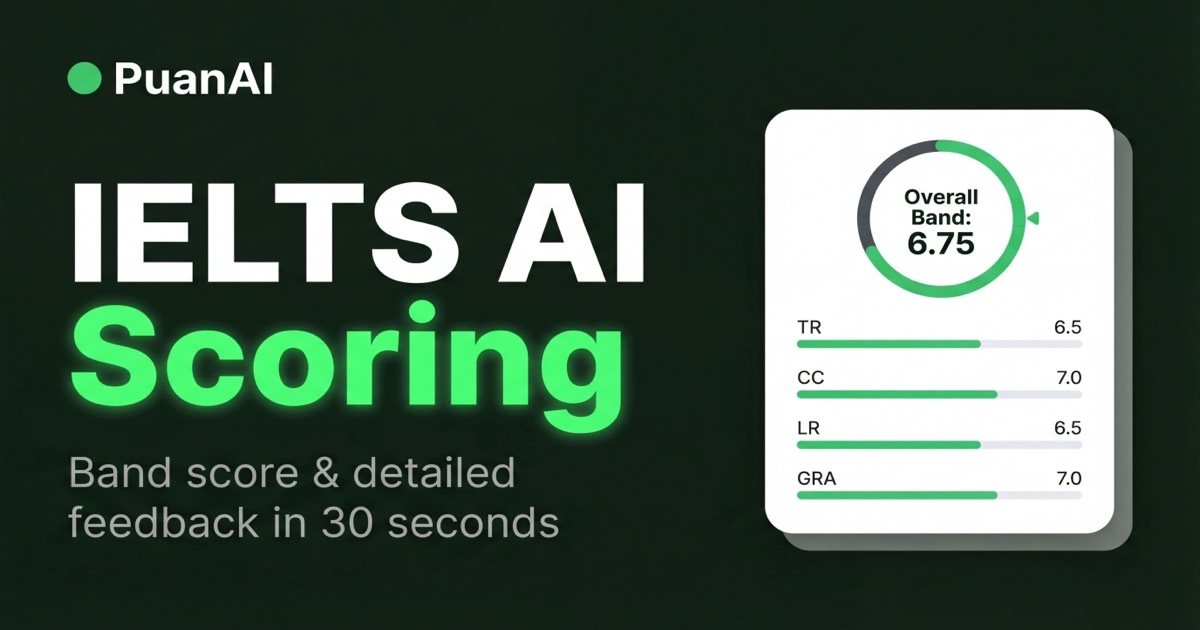
Modern AI scorers can evaluate your essay and return an estimated band score within seconds. The better tools break this down by all four criteria (TR, CC, LR, GRA), so you can see exactly where you are strong and where you need work. This is fundamentally different from getting a single overall score from a tutor with a comment like "needs improvement."
For example, PuanAI scores both Task 1 and Task 2 essays across all four IELTS criteria and delivers results in about 30 seconds. It provides detailed feedback in Turkish, English, and Korean — which matters significantly because understanding why you lost points is much easier in your native language. The tool offers one free attempt so you can test it without commitment.
Criterion-Specific Feedback
The real value of AI scorers is not the number — it is the explanation. A good tool will tell you that your Coherence score is low because your second paragraph lacks a clear topic sentence, or that your Lexical Resource could improve by replacing repeated words in paragraph three. This level of specificity helps you target your practice where it actually matters.
Rapid Practice Cycles
With a human tutor, you might get feedback on two or three essays per week. With an AI scorer, you can write an essay, get scored, revise based on the feedback, and submit again — all in under an hour. This rapid iteration is how skills improve fastest. Research in learning science consistently shows that immediate, specific feedback accelerates skill acquisition more than any other single factor.
The Consistency Advantage
Human examiners, despite their training, have some natural scoring variation. Studies published in language testing journals have documented that the same essay can receive scores that differ by 0.5 to 1.0 bands depending on the examiner. AI scorers, while not perfect, apply the same rubric identically every time. This consistency means you can track genuine improvement over time without worrying about examiner variability.
A Practical Strategy to Raise Your Writing Score
AI tools are powerful, but they work best as part of a structured approach. Here is a week-by-week strategy that combines AI feedback with deliberate practice:
Weeks 1-2: Establish Your Baseline
Write one Task 1 and one Task 2 essay under timed conditions (20 minutes for Task 1, 40 minutes for Task 2). Score them with an AI tool to get your baseline across all four criteria. Identify your two weakest areas — these are where you will focus first.
Weeks 3-4: Targeted Criterion Practice
If your weakest area is Task Response, spend two weeks exclusively practicing prompt analysis. Before writing, underline every part of the question and outline your response to ensure full coverage. If Coherence is your weakness, practice writing detailed paragraph plans before drafting.
For Lexical Resource, start a vocabulary notebook organized by IELTS topic areas (education, technology, environment, health, urbanization). Learn words in collocations, not isolation — "pose a threat" is more useful than just knowing "threat."
For Grammar, focus on the structures that give you the most trouble. Korean and Turkish speakers should pay special attention to articles, relative clauses, and conditional sentences.
Weeks 5-6: Full Essay Integration
Write complete essays under timed conditions, scoring each one with your AI tool. Track your scores in a simple spreadsheet with columns for each criterion. Look for patterns: is your TR improving while GRA stays flat? Adjust your practice accordingly.
Weeks 7-8: Speed and Refinement
By now your scores should be trending upward. Focus on exam-day skills: time management, proofreading speed, and stress tolerance. Practice writing essays in slightly less time than the exam allows (35 minutes for Task 2 instead of 40) so that the real test feels comfortable.
The Revision Technique
Here is a technique that leverages AI scoring exceptionally well: write an essay, score it, then revise the same essay based on the feedback and score it again. Comparing your original and revised scores gives you concrete evidence of what specific changes actually improve your band. Over time, those changes become automatic in your first drafts.
What to Look for in an AI IELTS Writing Scorer
Not all AI scoring tools are created equal. Here is what separates the genuinely useful ones from the gimmicks:
- All four criteria scored separately. A tool that only gives you an overall band score is not very helpful. You need the TR, CC, LR, and GRA breakdown to know where to focus.
- Task 1 and Task 2 support. Many tools only handle Task 2 opinion essays. Make sure yours also covers Task 1 (Academic: graphs, charts, diagrams; General Training: letters).
- Native language feedback. Understanding feedback in English is fine if your English is already at Band 7+. For most learners, feedback in their native language (whether that is Turkish, Korean, or another language) leads to faster improvement because they can focus on the writing skills rather than deciphering the feedback itself.
- Realistic scoring. Be wary of tools that consistently score you higher than your actual test results. A good AI scorer should be calibrated against real IELTS scoring standards, even if that means the numbers are not always flattering.
- Free trial or sample. You should be able to test the tool before paying. One scored essay is enough to judge whether the feedback is specific and actionable.
Tools like Cambridge's Write & Improve offer free basic feedback using the CEFR scale, while more specialized IELTS tools like PuanAI, IELTS Champ, and Cathoven AI provide direct band score estimates with varying levels of detail and language support.
The Bottom Line
IELTS Writing does not have to be the section that holds you back. The combination of understanding the scoring criteria, targeted practice on your weakest areas, and rapid AI-powered feedback creates a preparation loop that was simply not available a few years ago.
The global average Writing score sits around 5.5 to 6.0 for a reason: most candidates practice without specific, timely feedback. They write essays into a void, hoping they are improving but never knowing for sure. AI scoring tools close that gap by giving you the examiner perspective on demand.
Whether your target is 6.5 for university admission or 7.0+ for professional registration, the path is the same: write consistently, get scored on all four criteria, understand your weaknesses, and iterate. The tools to do this effectively are now accessible to anyone with an internet connection. The only variable left is how consistently you put in the work.