What Band 7 Really Means
Band 7 in IELTS Writing Task 2 is not about sounding academic or using rare words. It is about control. The official band descriptors point to a simple pattern: you answer the prompt fully, keep a clear position, move ideas in a logical order, support those ideas well enough, choose words accurately, and use a mix of grammar without letting errors take over. If your draft shows those things clearly before you submit, you are in the right territory.
That is also why the last five minutes matter so much. Task 2 carries twice the weight of Task 1. British Council advice is simple: plan before you write, use clear paragraphing, stay on topic, and reach at least 250 words. A strong idea can still lose marks if the final draft is thin, repetitive, or slightly off the question. This checklist is designed to catch those problems before they cost you a band.
Step 1: Check the Prompt First
Before you think about vocabulary or sentence variety, ask one question: does this essay answer the exact task? Many Band 6 answers are not weak because of grammar. They are weak because they discuss the topic in general terms but never land on the actual question. If the prompt asks for causes and solutions, or asks you to discuss both views, or asks for an opinion, the reader should see that answer immediately.
Identify the Task Type
Underline the command words in your head before you submit. Are you being asked to agree or disagree, discuss both views, explain a problem, compare advantages and disadvantages, or give reasons and solutions? The essay must match the task type exactly. If one paragraph is only describing the broader topic and never addresses the command word, it is a warning sign.
Lock Your Position
If the question asks for your opinion, your position must be clear from the introduction and remain stable to the end. Band 7 essays do not wobble between two sides just to sound balanced. They choose a line and support it. If your conclusion sounds different from your introduction, or if one body paragraph seems to argue against your own thesis, revise it before you submit.
Answer Every Part
Some questions have more than one part, and missing even one can damage Task Response quickly. Before you submit, scan each paragraph and ask whether it helps answer the prompt. If a paragraph could be deleted without changing the answer to the question, it may be too vague, too general, or too off-topic. The safest test is simple: can you explain in one sentence how each paragraph helps the task?
Step 2: Check Your Structure
A Band 7 essay is easy to follow because each paragraph has a job. The examiner should never wonder why a paragraph exists. Clear paragraphing is not decoration. It is part of how you show logical progression, and it helps the reader see that your ideas are organized rather than scattered.
Plan the Paragraph Job
Your introduction should paraphrase the task and show your position or direction. Each body paragraph should carry one main point, one clear explanation, and one form of support. Your conclusion should not introduce a new argument. It should simply confirm the position you have already built. If you still have a paragraph that is doing two or three jobs at once, the structure is probably not clean enough for Band 7.
Keep Each Body Paragraph Focused
One common pre-submit mistake is packing too many ideas into one body paragraph. When that happens, the paragraph becomes a list instead of an argument. A better check is this: can you summarize the paragraph in one short sentence? If not, it may need to be split or simplified. Focus makes it easier for the examiner to follow your reasoning and easier for you to stay on topic.
Add Enough Support
Band 7 does not require dramatic examples, but it does require enough support to make the argument feel complete. A claim on its own is weak. A claim plus a reason is better. A claim plus a reason plus a concrete example or consequence is stronger still. If a body paragraph ends after one unsupported sentence, add another sentence that explains why the idea matters.
Step 3: Run a Task Response Check
Task Response is the first place to look before you submit, because it asks whether you answered the question properly. This is the criterion that punishes essays which are technically written in English but do not fully respond to the task. Use this quick check before you stop editing:
- Did I answer every part of the prompt?
- Is my position clear and consistent?
- Did I stay on the same topic in every paragraph?
- Did I support my main points instead of just naming them?
- Did I write at least 250 words without padding the answer with filler?
If the essay is only just over the word limit and still feels thin, do not add decorative language. Add a real sentence of explanation, proof, or consequence. Band 7 answers are not longer because they are wordy. They are stronger because every paragraph earns its place.
Step 4: Run a Coherence and Cohesion Check
Coherence and Cohesion are where many otherwise good essays lose control. The problem is rarely a total lack of linking words. The problem is usually weak paragraph flow, mechanical transitions, or ideas that arrive in the wrong order. The reader should never have to do the sorting work for you.
Do the Links Match the Logic
Linking words should reflect the relationship between ideas, not just fill space. Use however for contrast, therefore for result, for example for illustration, and in addition for adding a related point. Do not stack the same connector at the start of every sentence. If the links feel repetitive, remove some of them and let the paragraph structure do the work.
Does Each Paragraph Start Clearly
The first sentence of each body paragraph should signal the point that follows. If the topic sentence is vague, the reader spends energy guessing. A good paragraph opening acts like a label. It tells the examiner why the paragraph exists and how it connects to the thesis. If the opening sentence is weak, rewrite it so the point is obvious within the first line.
Step 5: Run a Lexical Resource Check
Lexical Resource is where many candidates try to impress too hard. Band 7 is not built on rare vocabulary. It is built on accurate vocabulary. If the word is clever but slightly wrong, it hurts you more than a simple word used correctly. Before you submit, look for places where your language is vague, repetitive, or awkward.
Cut the Repeat Words
Repetition is one of the fastest ways to make an essay feel limited. If you have used important, people, problem, good, or bad over and over, replace some of those words with more precise alternatives. British Council guidance warns against repetitive language for a reason. Repetition makes the essay sound smaller than the ideas inside it.
Prefer Accurate Over Impressive
If you are unsure about a sophisticated synonym, do not gamble on it. A plain word that fits the meaning is better than an advanced word that sounds forced. Band 7 reflects control, not decoration. The examiner should get the feeling that you chose the exact word you needed, not the fanciest word available.
Check Your Collocations
A lot of vocabulary problems are really collocation problems. You may know the individual words, but the combination sounds unnatural. Make a decision, take action, pose a risk, and reach a conclusion are safer patterns than literal translations or word-for-word guesses. Before you submit, scan for phrases that look translated and replace them with natural combinations.
Step 6: Run a Grammar Range and Accuracy Check
Grammar Range and Accuracy is the last technical filter before submission. The goal is not to produce the longest sentence you can build. The goal is to show that you can use simple, compound, and complex structures while keeping control. A sentence that tries to be clever and becomes unclear is a bad trade.
Mix Sentence Types
Read the essay aloud in your head and notice whether most sentences look the same. If every line has the same rhythm, the grammar range is probably narrow. Band 7 writing usually shows a mix of short direct sentences and longer ones that combine ideas. Variety matters, but only when it stays readable.
Scan for the Usual Errors
Before you submit, check the errors that cost the most points: subject-verb agreement, articles, singular and plural forms, verb tense, prepositions, and punctuation. These are small mistakes individually, but they add up quickly. If one grammar issue appears several times, it is not a typo. It is a pattern, and patterns are what examiners notice.
Dont Let Complexity Break Control
Long sentences are useful only if they stay accurate. If a sentence has too many moving parts, split it. A shorter correct sentence is worth more than a long sentence that contains two errors. This is especially important when you are tired and trying to impress in the last minute. Control is the point of Band 7, not risk.
The Final Five-Minute Routine
When the draft is done, use the last five minutes in the same order every time.
- Read your thesis and compare it to the original prompt.
- Read each body topic sentence and check whether it supports the thesis.
- Delete or fix any sentence that drifts off topic.
- Check that the conclusion matches the position you stated at the start.
- Count the words and add one real sentence if you are still below 250.
- Do one final grammar sweep for the most common errors.
If you are close to the limit and the essay still feels thin, do not add filler. Add explanation. If the logic feels weak, do not add a flashy phrase. Add support. If the grammar feels shaky, shorten the sentence. The fastest improvements at the end are usually the most practical ones.
How PuanAI Fits Into Practice
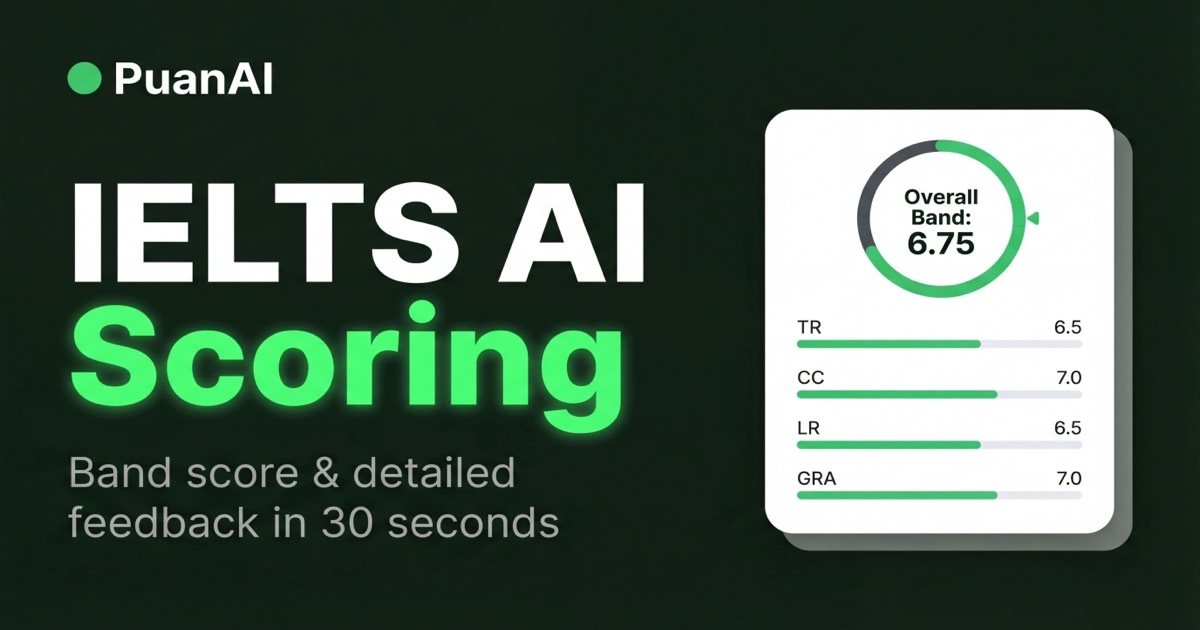
Self-studying candidates often know what they need to fix, but they do not know whether the fix actually improved the essay. That is where a fast feedback loop helps. PuanAI scores both Task 1 and Task 2, gives TR, CC, LR, and GRA feedback, supports Turkish and Korean feedback, and returns a score in about 30 seconds. You can try it here: PuanAI.
Final Pre-Submit Checklist
- Did I answer every part of the prompt?
- Is my position clear and consistent?
- Does each body paragraph do one job only?
- Did I support my ideas with enough explanation?
- Do my linkers match the logic of the ideas?
- Did I avoid repeating the same words too often?
- Did I mix sentence types without losing control?
- Did I remove the biggest grammar errors?
- Is the essay at least 250 words?
If you can tick all of those boxes, you are not submitting a perfect essay. No one does. But you are submitting a controlled essay, and that is usually what Band 7 looks like in practice. Before you click submit, look once more at the weakest criterion, fix that one thing, and then stop editing.