Why Task 1 Matters More Than You Think
Most IELTS candidates pour their energy into Task 2 and treat Task 1 as an afterthought. That is a costly mistake. Task 1 accounts for one-third of your overall Writing band score, and it is often the area where students lose marks they could have easily kept with the right preparation.
Here is the good news: unlike Task 2, which requires you to generate original arguments and opinions, Task 1 is fundamentally a reporting exercise. You are given visual data — a line graph, bar chart, pie chart, table, process diagram, or map — and your job is to describe what you see. No opinions needed. No creative arguments required. Just accurate, well-organized reporting of the information in front of you.
That means Task 1 is the most learnable part of the IELTS Writing test. Once you understand the structure, learn the right vocabulary, and practice avoiding a handful of common mistakes, your score can improve rapidly. This guide will walk you through everything you need to know to consistently score Band 7 or higher on Task 1.
Understanding the Task: What Examiners Actually Want
Before diving into strategies, you need to understand exactly what IELTS Task 1 asks of you and how it is graded. In the Academic version, you will receive a visual — most commonly a line graph, bar chart, pie chart, or table — along with a brief description. You must write at least 150 words in about 20 minutes.
Your response is evaluated across four criteria, each worth 25% of your Task 1 score:
- Task Achievement (TA) — Did you cover all key features of the visual? Did you include an overview? Did you support descriptions with specific data?
- Coherence and Cohesion (CC) — Is your report logically organized? Do your paragraphs flow smoothly? Are linking words used naturally?
- Lexical Resource (LR) — Do you use a range of vocabulary accurately? Can you paraphrase the question effectively?
- Grammatical Range and Accuracy (GRA) — Can you write complex sentences accurately? Do you use a variety of structures?
The most important thing to understand is that the overview is the single most important element for Task Achievement. According to the official IELTS band descriptors, a response without a clear overview cannot score above Band 5 in Task Achievement. That one paragraph can make or break your score.
The Four-Paragraph Structure That Works Every Time
Consistency is your friend in IELTS Writing. Use the same structure for every Task 1 response, regardless of whether you get a line graph, bar chart, or table. An examiner should be able to understand your entire report by reading just the first two paragraphs.
Paragraph 1: Introduction (Paraphrase the Question)
Your introduction has one simple job: tell the reader what the visual shows. Do not copy the question word for word. Instead, paraphrase it using synonyms and different sentence structures.
Question: "The graph below shows the number of international students enrolled in three universities between 2010 and 2020."
Bad introduction (copied): "The graph below shows the number of international students enrolled in three universities between 2010 and 2020."
Good introduction (paraphrased): "The line graph illustrates the enrollment figures for overseas students at three different universities over the period from 2010 to 2020."
Notice how "international students" became "overseas students," "number" became "enrollment figures," "shows" became "illustrates," and "between 2010 and 2020" became "over the period from 2010 to 2020." This paraphrasing immediately demonstrates lexical range to the examiner.
Paragraph 2: Overview (The Most Important Paragraph)
Your overview summarizes the 2-3 most significant trends or features from the visual. Start with a clear signal word like "Overall" or "In general" so the examiner knows exactly where your overview is.
Crucially, do not include specific numbers in your overview. The overview should describe the big picture — the overall trends, the largest differences, the most notable patterns — without getting into data details.
Example overview: "Overall, University A experienced the most significant growth in international student numbers over the decade, while University C saw a gradual decline. University B maintained relatively stable enrollment throughout the period."
This overview identifies three distinct patterns (growth, decline, stability) without citing any specific figures. That is exactly what examiners want.
Paragraph 3: Body 1 (First Group of Details)
Now you provide specific data to support the trends you identified in your overview. Group related information together logically. For instance, if you have two categories that both showed an upward trend, describe them together in the same paragraph.
Example: "In 2010, University A had approximately 5,000 international students, making it the smallest of the three institutions in terms of overseas enrollment. However, this figure rose steadily throughout the decade, reaching a peak of 18,500 in 2019 before settling at around 17,000 in 2020."
Paragraph 4: Body 2 (Second Group of Details)
Cover the remaining data, again with specific numbers and logical grouping.
Example: "University B started the period with roughly 12,000 international students and fluctuated between 11,000 and 13,500 over the decade, ending at 12,800 in 2020. By contrast, University C began with the highest enrollment at 15,000 but declined gradually to just under 9,000 by the end of the period."
This four-paragraph structure works for virtually every Task 1 question type. Master it, and you eliminate one major source of stress on exam day.
Essential Vocabulary for Describing Trends
One of the fastest ways to boost your Lexical Resource score is to build a strong toolkit of trend vocabulary. Examiners want to see that you can describe changes in data using varied and precise language. Here are the categories you need to master:
Upward Trends
Do not just write "increased" every time the data goes up. Use varied language:
- Verbs: increased, rose, grew, climbed, surged, soared, jumped, rocketed, expanded
- Nouns: an increase, a rise, a growth, a surge, an upward trend, an expansion
Examples in context:
- "Sales rose sharply from 200 to 850 units in the first quarter."
- "There was a significant increase in enrollment between 2015 and 2018."
- "The number of visitors climbed steadily over the five-year period."
Downward Trends
- Verbs: decreased, declined, fell, dropped, plummeted, plunged, shrank, dipped
- Nouns: a decrease, a decline, a fall, a drop, a reduction, a downward trend
Examples in context:
- "Exports declined gradually from 2012 to 2016."
- "There was a sharp drop in production during the third quarter."
- "The proportion of rural workers fell significantly over the decade."
Stability and Fluctuation
- Stable: remained stable, stayed constant, leveled off, plateaued, remained unchanged
- Fluctuation: fluctuated, varied, oscillated between X and Y
Examples in context:
- "After the initial rise, figures remained stable at around 4,000."
- "The rate fluctuated between 3% and 5% throughout the period."
- "Following the peak in 2015, the number leveled off at approximately 12,000."
Degree Modifiers: Making Your Descriptions Precise
What separates a Band 6 description from a Band 7 description is often the precision of your modifiers. Instead of just saying "increased," specify how it increased:
- Dramatic change: sharply, dramatically, significantly, substantially, considerably, rapidly
- Moderate change: moderately, noticeably, reasonably
- Small change: slightly, marginally, minimally, fractionally
- Steady change: steadily, gradually, progressively, consistently
Tip: You can use these as adverbs with verbs ("rose sharply") or as adjectives with nouns ("a sharp rise"). Demonstrating both forms shows grammatical range.
Approximation Language
You will rarely need to state exact figures. Use approximation language to show flexibility:
- approximately, roughly, around, about, just over, just under, nearly, close to
Example: "The figure stood at approximately 25,000 in 2015, before rising to just over 30,000 by 2018."
Comparison Language That Pushes You Into Higher Bands
Task 1 is fundamentally about comparing data. Examiners specifically look for how well you draw comparisons between different categories, time periods, or values. Here are structures that demonstrate range:
Comparative and Superlative Structures
- "Country A had significantly more exports than Country B."
- "University C recorded the highest number of applicants among the three institutions."
- "The gap between urban and rural populations widened considerably over the period."
While / Whereas / In contrast
- "While oil consumption increased sharply, coal usage declined at a similar rate."
- "Whereas Group A showed consistent growth, Group B remained relatively static."
- "Spending on education rose by 15%. By contrast, healthcare spending fell by 8%."
Proportion and Ratio Language (for Pie Charts and Tables)
- "accounted for," "comprised," "made up," "represented"
- "The largest proportion of spending went to housing, accounting for 35% of total expenditure."
- "Food made up roughly one-quarter of the monthly budget."
Seven Common Mistakes That Cost You Marks
Understanding what not to do is just as important as knowing what to do. These are the mistakes examiners see most frequently in Task 1 responses:
Mistake 1: Missing or Weak Overview
This is the single biggest score limiter. Without a clear overview that summarizes the main trends, your Task Achievement score is capped at Band 5 regardless of how detailed your body paragraphs are. Always write a dedicated overview paragraph starting with "Overall" or "In general."
Mistake 2: Giving Opinions or Explanations
Task 1 is a reporting task, not an opinion task. Never write sentences like "This increase happened because the economy was growing" or "I think the government should do something about this decline." You are describing data, not analyzing causes or suggesting solutions. Examiners will penalize you for going beyond the data.
Mistake 3: Trying to Describe Every Single Data Point
If a bar chart has 12 bars across 4 categories, you do not need to mention all 12 values. Select the most significant features: the highest and lowest points, the biggest changes, the clearest trends. Band 7+ candidates are selective. They highlight what matters and leave out what does not add value.
Mistake 4: Writing Without Specific Data
The opposite mistake is also common: writing general statements without any supporting numbers. "The number increased over the period" is too vague. "The number increased from 5,000 in 2010 to 12,000 in 2020" gives the examiner evidence that you can accurately read and report the visual. Your body paragraphs should be full of specific figures.
Mistake 5: Copying the Question Word for Word
If you copy the question statement directly into your introduction, those words are not counted toward your word count, and you miss an easy opportunity to demonstrate vocabulary range. Always paraphrase.
Mistake 6: Mechanical or Overused Linking Words
Starting every sentence with "Furthermore," "Moreover," or "In addition" makes your writing sound formulaic. Use linking words naturally and vary them: "while," "whereas," "by contrast," "similarly," "at the same time," "on the other hand," "followed by." The goal is to connect ideas logically, not to checkbox a list of connectors.
Mistake 7: Poor Time Management
You have approximately 20 minutes for Task 1. Spend 2-3 minutes analyzing the visual and planning your response, 12-14 minutes writing, and 3-4 minutes proofreading. Many candidates spend too long on Task 1 and then rush Task 2, which is worth twice the marks. Practice writing Task 1 responses within 18 minutes so the real exam feels comfortable.
Five Strategies That Separate Band 7 From Band 6
Getting from Band 6 to Band 7 is not about writing more or using fancier words. It is about making specific, targetable improvements in how you approach the task.
Strategy 1: Spend 2-3 Minutes Analyzing Before Writing
Band 7+ candidates do not start writing immediately. They study the visual first: What is the overall trend? What stands out? What are the highest and lowest points? Which items can be grouped together? This analysis time prevents the scattered, unfocused reports that keep scores at Band 6.
Strategy 2: Group Data Logically Instead of Chronologically
A common Band 6 pattern is to describe data year by year: "In 2010... In 2011... In 2012..." This approach produces a list, not a report. Band 7 candidates group data by pattern: "Countries A and C both showed upward trends... In contrast, Countries B and D experienced declining figures." Grouping by pattern demonstrates analytical thinking.
Strategy 3: Vary Your Sentence Structures
Band 7 requires "a variety of complex structures" in grammar. Mix these patterns:
- Simple: "Sales reached 50,000 units in 2018."
- Compound: "Sales rose in the first half, but they declined in the second."
- Complex: "After peaking at 50,000 in 2018, sales fell steadily to 35,000 by 2020."
- Passive: "The highest figures were recorded in the final year of the period."
You do not need to use complex structures in every sentence. A natural mix is what examiners look for.
Strategy 4: Practice All Chart Types, Not Just Line Graphs
Many candidates only practice with line graphs and then freeze when they encounter a process diagram, map, or dual-chart question on exam day. Make sure you are comfortable with:
- Line graphs — trends over time
- Bar charts — comparisons across categories
- Pie charts — proportions and percentages
- Tables — detailed numerical comparisons
- Process diagrams — sequential steps in a process (use passive voice)
- Maps — changes in a location over time
Each type has its own vocabulary and structural emphasis. A process diagram, for instance, requires sequencing language ("firstly," "following this," "subsequently," "at the final stage") and passive voice ("the materials are transported," "the mixture is heated"). Practice all types so nothing surprises you on test day.
Strategy 5: Proofread With a Checklist
In the final 3-4 minutes, do not just re-read your response vaguely. Use a mental checklist:
- Did I include an overview?
- Did I use specific numbers in my body paragraphs?
- Did I check subject-verb agreement?
- Did I use articles (a/an/the) correctly?
- Did I write at least 150 words?
For Korean speakers, article usage ("a," "the," no article) is the most common grammatical error since Korean does not use articles. For Turkish speakers, pay special attention to prepositions and article placement. These small corrections during proofreading can save half a band in GRA.
Practice Makes Progress: Building a Feedback Loop
Knowing the theory is essential, but improvement only happens through deliberate practice with feedback. The challenge most IELTS candidates face is that they write Task 1 responses but have no reliable way to know whether they are improving.
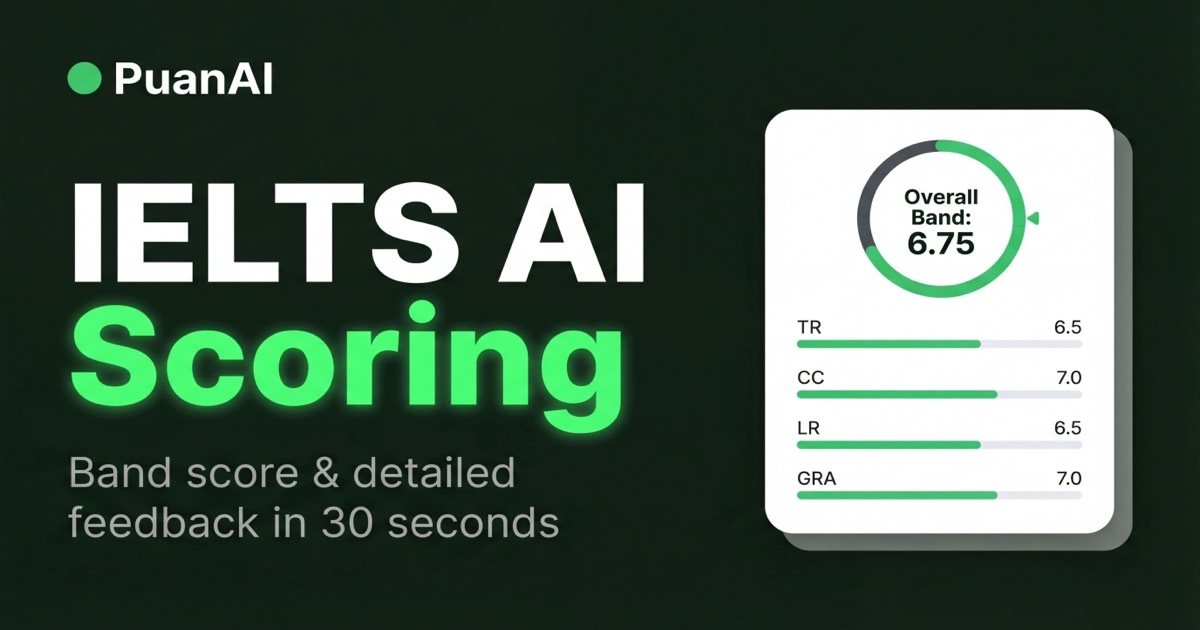
This is where AI-powered scoring tools can be genuinely useful. Instead of writing essays into a void and hoping for the best, you can get immediate feedback on each criterion. PuanAI, for example, scores both Task 1 and Task 2 across all four IELTS criteria and returns results in about 30 seconds. It also provides feedback in English, Korean, and Turkish, which helps you understand exactly where you lost marks without struggling to interpret the feedback itself.
The most effective practice method is the write-score-revise cycle: write a Task 1 response under timed conditions, score it, study the feedback, revise the same response addressing the specific issues identified, and score it again. Comparing your original and revised scores gives you concrete proof of which changes actually move your band upward. Over time, those improvements become automatic in your first drafts.
Whether you use an AI tool, a tutor, or peer feedback, the principle is the same: practice without specific feedback is just repetition. Practice with targeted feedback is how skills actually develop.
Quick Reference Checklist for Exam Day
Keep this checklist in your mind on test day:
- Minutes 0-3: Read the question. Study the visual. Identify 2-3 key features. Plan your grouping.
- Minutes 3-5: Write your introduction (paraphrase the question) and overview (main trends, no specific data).
- Minutes 5-15: Write two body paragraphs with specific data supporting your overview points. Group logically, not chronologically.
- Minutes 15-18: Proofread using your checklist. Check word count. Fix article and tense errors.
- Minutes 18-20: Final read-through. Move on to Task 2.
Remember: Task 1 is worth one-third of your Writing score, and Task 2 is worth two-thirds. Do not spend more than 20 minutes on Task 1 no matter how tempting it is to perfect it. A well-practiced candidate can write a strong Band 7 Task 1 response in 18 minutes and carry that confidence into Task 2.
You Are Closer Than You Think
Task 1 is the most structured and predictable part of the IELTS Writing test. Unlike Task 2, where you might face a topic you have never thought about before, Task 1 always follows the same pattern: here is visual data, describe it. The vocabulary is finite and learnable. The structure is repeatable. The common mistakes are well-documented and avoidable.
If you are currently scoring Band 6 in Task 1, you are probably only a few targeted improvements away from Band 7. Maybe your overview needs to be clearer. Maybe you need more precise modifiers. Maybe your body paragraphs lack specific data, or your comparisons could be more varied. Each of these is a specific, fixable issue.
Start by mastering the four-paragraph structure. Build your vocabulary toolkit using the word lists in this guide. Practice with all chart types, not just your comfortable ones. Get scored feedback — whether through PuanAI or another reliable method — and track your progress across all four criteria. The path from Band 6 to Band 7 in Task 1 is well-defined. You just need to walk it consistently.