Why Nebenkosten Matter More Than You Think
If you rent an apartment in Germany, your monthly payment consists of two parts: Kaltmiete (the base rent) and Nebenkosten (the ancillary operating costs). Together they form your Warmmiete, the total you transfer each month. The Nebenkosten portion covers building-level expenses such as heating, water, waste collection, building insurance, and maintenance of common areas.
Here is the part that catches many tenants off guard: the monthly Nebenkosten amount you pay is only an estimate. Once a year, your landlord tallies the actual costs and sends you a settlement document called the Nebenkostenabrechnung. If you overpaid, you get a refund. If you underpaid, you owe a back payment (Nachzahlung). For an average 80-square-meter apartment in Germany, the annual Nebenkosten total can reach 2,500 euros or more — so the stakes are real.
What makes this even more significant is a statistic from the Deutscher Mieterbund (German Tenants' Association): roughly every second Nebenkostenabrechnung contains errors. That means approximately half of all annual utility settlements in Germany are wrong — too high, too late, or too imprecise. For expats who may struggle with the language or lack familiarity with the system, this creates a genuine risk of overpaying.
This article is a detailed guide to your rights as a tenant regarding Nebenkosten in Germany. We will cover what you can legally challenge, the critical deadlines you need to know, the most common overcharges landlords make, and practical steps you can take to protect yourself.
What Landlords Can and Cannot Charge
German law is specific about which operating costs a landlord may pass on to tenants. The Betriebskostenverordnung (Operating Costs Regulation) provides an exhaustive list. Understanding this list is the first step in knowing your rights.
Legally Permitted Charges
The following categories of costs may be included in your Nebenkosten:
- Heating and hot water (Heizung und Warmwasser) — typically the largest single item, averaging around 1.32 EUR per square meter per month.
- Cold water and sewage (Wasser und Abwasser) — supply of fresh water and wastewater disposal.
- Property tax (Grundsteuer) — the municipal property tax allocated proportionally across all units in the building.
- Waste collection (Muellabfuhr) — garbage pickup, recycling, and waste disposal services.
- Building cleaning (Gebaeudereinigung) — regular cleaning of stairwells, hallways, and common areas.
- Elevator operation (Aufzug) — maintenance, inspection, and electricity for the elevator, if the building has one.
- Building insurance (Gebaeudeversicherung) — fire, water damage, storm damage, and liability coverage.
- Garden maintenance (Gartenpflege) — upkeep of communal outdoor spaces and green areas.
- Caretaker services (Hauswart/Hausmeister) — costs for a building caretaker who handles routine tasks.
- Chimney sweep (Schornsteinfeger) — legally mandated inspections and cleaning.
- Antenna and cable TV (Antenne/Kabel) — shared antenna or cable connection costs.
- Street cleaning and winter services (Strassenreinigung und Winterdienst) — clearing snow and maintaining public-facing sidewalks adjacent to the property.
According to the Deutscher Mieterbund, the national average for total Nebenkosten sits at approximately 2.67 EUR per square meter per month. When every possible cost category is included, this figure can climb to 3.68 EUR per square meter.
Charges Your Landlord Cannot Include
Equally critical is knowing what must not appear on your settlement. German law explicitly prohibits the following from being passed on to tenants:
- Repairs and maintenance (Instandhaltung) — fixing broken pipes, replacing a boiler, repainting common areas, or any work that restores the building to its original condition.
- Administrative costs (Verwaltungskosten) — the landlord's own management fees, the cost of a property management company, or the landlord's time spent administering the building.
- Vacancy costs — if another unit in the building is empty, its proportional share of operating costs cannot be redistributed to occupied tenants.
- One-time capital investments — installation of new equipment, modernization projects, or building upgrades.
- Bank fees — the landlord's mortgage costs, account fees, or financing charges.
- Legal costs — fees the landlord incurs for legal disputes with other tenants or third parties.
If any of these items appear on your Nebenkostenabrechnung, you have a clear legal basis to challenge them.
The Critical Deadlines You Must Know
German tenancy law establishes strict deadlines that protect tenants. These deadlines are non-negotiable, and understanding them gives you significant leverage.
The 12-Month Delivery Deadline
Under BGB § 556 Abs. 3 (the German Civil Code), the landlord must deliver the Nebenkostenabrechnung to the tenant within 12 months after the end of the billing period. If your billing period runs from January to December 2025, the settlement must reach you by December 31, 2026 at the latest.
The consequences of missing this deadline are severe for the landlord:
- Lost right to back payment: If the landlord delivers the settlement late, they forfeit the right to demand any Nachzahlung from you. Even if the actual costs exceeded your prepayments, the landlord cannot collect the difference. The only exception is if the landlord can prove the delay was not their fault — for example, a utility company failed to provide consumption data on time — but this defense rarely succeeds in court.
- Your refund is still valid: Importantly, the 12-month deadline only blocks the landlord's claims against you. If the late settlement shows that you overpaid, you can still claim your refund. The deadline is asymmetric — it protects the tenant, not the landlord.
- Already paid a late Nachzahlung? If you paid a back payment on a settlement that arrived after the 12-month window, you may be entitled to reclaim that money. The landlord received an unjust enrichment, and you have grounds to demand repayment.
The 12-Month Objection Deadline
Once you receive the Nebenkostenabrechnung, you have 12 months to raise formal objections. If the settlement arrives in your mailbox in March 2026, your deadline to challenge it is March 2027.
This is a generous window, but do not let it lull you into complacency. The sooner you review the document, the sooner you can request supporting documents and gather the evidence you need for a formal objection.
The 30-Day Payment Deadline
If the settlement shows a Nachzahlung, you generally have 30 days from receipt to pay it. German courts have established that tenants should pay the back payment on time, even if they plan to dispute the settlement afterward. If your objection succeeds, the overpaid amount will be refunded to you. Refusing to pay upfront can lead to legal complications, including potential eviction proceedings in extreme cases.
Keeping Track of Dates
Always record the date you received the settlement. This date starts both your 12-month objection clock and allows you to verify whether the landlord met their own delivery deadline. If the billing period ended in December 2025 but the letter only arrived in February 2027, the landlord has missed the deadline and you owe nothing in back payments.
Common Nebenkosten Overcharges and Errors
Based on data from tenant associations and legal advisory services across Germany, certain types of errors appear again and again in Nebenkostenabrechnungen. Knowing what to look for dramatically improves your chances of catching problems.
Repair Costs Disguised as Operating Costs
This is one of the most frequent violations. A landlord replaces a broken heating pump and lists the cost under "Heizung" (heating) in the Nebenkostenabrechnung. Or a plumber fixes a leaking pipe in the basement, and the invoice appears under building maintenance. Repairs are not operating costs. They are the landlord's responsibility and cannot be charged to tenants under any circumstances.
Unfair Distribution Keys
The distribution key (Verteilerschluessel) determines how building-wide costs are split among tenants. The most common method is by apartment size in square meters. However, some costs — particularly water — should be distributed by actual consumption or number of occupants when meters are available.
German courts have intervened in cases where the distribution method was clearly unfair. In one notable case, a family of five and a single-person household were charged the same amount for water despite vastly different consumption levels. The court ordered the landlord to install meters and reallocate costs based on actual usage.
For heating costs specifically, German law (Heizkostenverordnung) requires that at least 50% and up to 70% of heating costs be allocated based on individual consumption, not just apartment size. If your entire heating bill is calculated by square meters alone, this is likely a legal violation.
Charges for Nonexistent Amenities
It may sound unlikely, but tenant associations regularly report cases where tenants are charged for an elevator in a building without one, for garden maintenance where there is no garden, or for a caretaker who does not exist. Always verify that each line item on your settlement corresponds to an actual service or amenity in your building.
Inflated or Fabricated Costs
Some landlords inflate existing costs or include expenses that never occurred. This is why the right to Belegeinsicht (inspection of supporting documents) is so important. When you request to see the original invoices and receipts, fabricated charges fall apart quickly.
Missing Formal Requirements
A valid Nebenkostenabrechnung must contain specific elements: the billing period, total building costs per category, the distribution key used, your individual share of each cost, and your total prepayments with the resulting balance. If any of these elements are missing, the settlement may be formally invalid, and the landlord cannot enforce a back payment based on an invalid document.
Incorrect Apartment Size
If costs are distributed by square meters, the size of your apartment in the settlement must match the size stated in your rental contract. Discrepancies happen more often than you might expect — sometimes due to carelessness, sometimes due to incorrect building records. Even a few square meters of difference can change your annual Nebenkosten by a meaningful amount.
Your Rights: A Step-by-Step Guide to Challenging Nebenkosten
If you have identified errors or suspicious charges in your Nebenkostenabrechnung, here is how to exercise your rights effectively.
Step 1: Review the Settlement Thoroughly
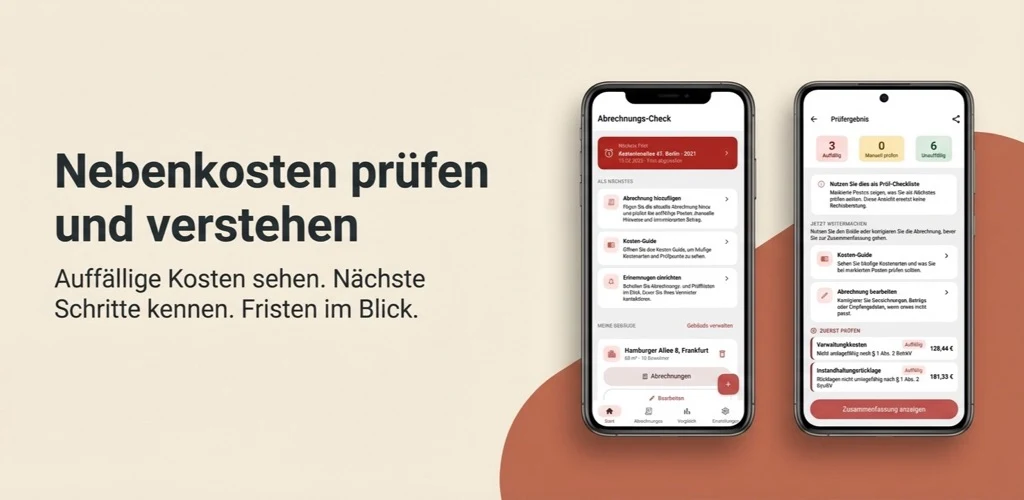
Go through each line item systematically. Compare costs with previous years. Check that the distribution key is fair and consistent. Verify that only legally permitted costs are included. Look for sudden, unexplained increases. This initial review is something you can do yourself, and tools like NeiboCheck are designed to help with exactly this process — the app analyzes your Nebenkostenabrechnung line by line, flags unusual costs, and helps you keep track of critical deadlines. Available on Android in both English and German, it is particularly useful for expats who want a structured way to review their settlement without needing fluent German.
Step 2: Request Supporting Documents (Belegeinsicht)
You have the legal right to inspect the original invoices, contracts, and receipts that underpin every line item in your settlement. This is called Belegeinsicht, and it is guaranteed by German tenancy law. You can request to view these documents at your landlord's office or ask for copies. If the landlord refuses to provide access, the charges become unproven, and a court will likely invalidate them.
Make your request in writing. A simple letter or email stating that you wish to exercise your right to Belegeinsicht for the specific billing year is sufficient. Set a reasonable deadline (two to three weeks is standard).
Step 3: File a Written Objection (Widerspruch)
If you find errors, send a formal written objection to your landlord. While email is acceptable, a registered letter (Einschreiben) provides proof that your objection was received. In your letter, specify exactly which line items you are disputing and state the reasons for each objection.
Be factual and precise. For example: "The settlement includes 850 EUR for Hauswart (caretaker) services. According to the invoices I reviewed during Belegeinsicht, 320 EUR of this amount relates to repair work on the building entrance door. Repair costs are not allocable operating costs under the Betriebskostenverordnung and must be removed from the settlement."
Step 4: Pay First, Dispute Later
German courts have consistently ruled that tenants should pay the Nachzahlung by the due date, even while pursuing an objection. If your challenge is successful, the overpaid amount will be refunded. Refusing to pay can lead to warnings, late fees, or in prolonged cases, legal action from the landlord. The safer strategy is to pay under protest and pursue your claim afterward.
Step 5: Get Professional Support
Consider joining a Mieterverein (tenant association). Germany has tenant associations in virtually every city, and membership typically costs between 60 and 100 EUR per year. In return, you get access to legal advice, professional review of your Nebenkostenabrechnung, and representation in disputes with your landlord. The Mieterverein advisors are experts who catch errors that most people would miss.
If the amounts involved are large or the dispute escalates, consult a lawyer specializing in Mietrecht (tenancy law). Many tenant associations provide legal referrals as part of their membership.
Practical Advice for Expats in Germany
Living in Germany as a foreigner adds an extra layer of complexity to dealing with Nebenkosten. The language barrier, unfamiliarity with German bureaucracy, and the sheer density of legal documents can make the process feel overwhelming. Here are concrete tips that address these challenges.
Understand Your Lease Before Signing
Before you sign, check which costs are included in your Nebenkosten prepayment and which you pay separately (electricity, for example, is almost always a direct contract with an energy provider). Ask your landlord to explain the estimated breakdown. If you do not speak German fluently, request a translated summary of the Nebenkosten clause or have a German-speaking friend review it.
Learn the Essential German Terms
You do not need to be fluent, but knowing a handful of key terms will help you navigate the annual settlement:
- Nachzahlung — back payment (you owe more)
- Guthaben — credit/refund (you overpaid)
- Vorauszahlung — monthly prepayment
- Verteilerschluessel — distribution key
- Abrechnungszeitraum — billing period
- Belegeinsicht — right to inspect supporting documents
- Widerspruch — formal objection
- Einschreiben — registered letter
Save Every Settlement
Keep a digital or paper copy of each annual Nebenkostenabrechnung. Year-over-year comparison is the easiest and most effective way to spot anomalies. A cost that doubles without explanation deserves investigation.
Record the Delivery Date
The moment you receive the settlement, write down the date. This is the starting point for your 12-month objection window and also lets you verify whether the landlord met their own 12-month delivery deadline.
Budget for Back Payments
Especially in your first year of renting in Germany, it is common to owe a Nachzahlung. The initial Nebenkosten estimate may have been set too low, or your actual energy consumption may have exceeded the average. Setting aside an extra 50 to 100 EUR per month beyond your Warmmiete creates a financial buffer that prevents unpleasant surprises.
Do Not Ignore the Settlement
The worst thing you can do is toss the Nebenkostenabrechnung in a drawer because it looks complicated or is written in unfamiliar German. Every year, tenants across Germany lose hundreds of euros simply because they never reviewed their bill. With tools like NeiboCheck available to guide you through each line item in English or German, there is no reason to leave money on the table.
Know That the Law Is on Your Side
German tenancy law is widely regarded as one of the most tenant-friendly legal frameworks in Europe. The protections described in this article are not theoretical — they are enforced by courts on a daily basis. Your landlord has a legal obligation to be transparent about operating costs. You have the right to see every receipt, challenge every calculation, and get your money back if you were overcharged. Being an expat does not diminish these rights in any way.
When to Seek Legal Help
Most Nebenkosten disputes can be resolved through written objections and Mieterverein support. However, there are situations where professional legal assistance becomes advisable:
- Your landlord refuses to provide Belegeinsicht despite repeated written requests.
- The disputed amount is substantial (several hundred euros or more).
- Your landlord threatens legal action or eviction in response to your objection.
- The landlord systematically overcharges across multiple billing years.
- You have already moved out but are disputing a final Nebenkostenabrechnung.
In these cases, a lawyer specializing in Mietrecht can send a formal legal letter, negotiate on your behalf, or represent you in court if necessary. Legal expenses insurance (Rechtsschutzversicherung) that covers tenancy law disputes is available in Germany and may be worth considering if you plan to rent long-term.
Conclusion: Review Your Settlement, Protect Your Money
The Nebenkostenabrechnung is one of those uniquely German institutions that can feel intimidating, especially if you are new to the country. But the system, while complex, is built on a foundation of tenant protection. You have the right to a timely, accurate, and transparent accounting of your building's operating costs. You have the right to inspect the evidence behind every charge. And you have 12 months to challenge anything that does not look right.
Given that roughly half of all Nebenkostenabrechnungen contain errors, the probability that reviewing yours will uncover something worth questioning is genuinely high. Whether you do it yourself, join a Mieterverein, or use an app like NeiboCheck to walk you through the process, investing 30 minutes in reviewing your annual settlement could save you hundreds of euros.
Do not let the language barrier or bureaucratic complexity stop you from exercising your rights. The law is clear, the protections are strong, and the tools to help you are readily available.