What Is a Refrigerant PT Chart and Why It Matters
A refrigerant pressure-temperature (PT) chart is the single most referenced tool in HVAC and refrigeration work. It shows the direct relationship between a refrigerant's pressure and its saturation temperature — the temperature at which the refrigerant changes phase between liquid and vapor. If you know one value, you can determine the other instantly.
This relationship is the foundation of every diagnostic measurement you make in the field. Whether you are checking superheat, calculating subcooling, determining if a system is properly charged, or diagnosing a restriction, the PT chart is where it all starts. Without it, your gauge readings are just numbers without meaning.
Every refrigerant has its own unique pressure-temperature curve. R-410A operates at significantly higher pressures than R-22. R-134a runs at lower pressures than either of them. R-32 sits between R-410A and R-22. Understanding these differences is not optional — connecting gauges to an R-410A system and reading pressures as if it were R-22 will lead to completely wrong conclusions about the system's condition.
How to Read a PT Chart: The Fundamentals
A standard PT chart is laid out as a simple table. One column lists temperatures (in Fahrenheit or Celsius), and the adjacent column shows the corresponding saturation pressure (in psig or kPa) for a specific refrigerant. Some charts include multiple refrigerants side by side for quick comparison.
Reading Charts for Single-Component Refrigerants
For pure (single-component) refrigerants like R-22, R-32, and R-134a, reading a PT chart is straightforward. There is one pressure value for each temperature. At a given pressure, the refrigerant boils and condenses at exactly one temperature. If your low-side gauge reads 68.5 psig on an R-22 system, the saturation temperature at the evaporator is 40 degrees F. If the high-side gauge reads 260 psig, the condenser saturation temperature is 120 degrees F.
This one-to-one relationship makes pure refrigerants simpler to work with. One gauge reading gives you one saturation temperature, no ambiguity.
Reading Charts for Refrigerant Blends (Zeotropic Mixtures)
Refrigerant blends like R-410A, R-407C, and R-454B behave differently. These are zeotropic mixtures, meaning they do not boil and condense at a single temperature. Instead, they have a temperature range called glide. At any given pressure, there are two relevant temperatures: the bubble point (where the liquid starts to boil) and the dew point (where the last droplet of liquid evaporates into vapor).
PT charts for blends therefore have two columns per refrigerant: one for the bubble point (liquid side) and one for the dew point (vapor side). The difference between these two temperatures is the glide.
Here is the critical rule that trips up many technicians:
- For superheat calculations, use the dew point (vapor column) — because you are comparing against vapor leaving the evaporator.
- For subcooling calculations, use the bubble point (liquid column) — because you are comparing against liquid leaving the condenser.
R-410A has a negligible glide (less than 0.3 degrees F), so its bubble and dew points are nearly identical, and it behaves almost like a pure refrigerant. R-407C, on the other hand, has a glide of about 10 degrees F, which makes the distinction between bubble and dew point critical for accurate readings.
Common Refrigerants and Their PT Values
Understanding the typical operating pressures for the refrigerants you work with most often is essential. Here are reference values for four of the most common refrigerants at key temperatures that HVAC technicians encounter regularly.
R-410A
R-410A is the dominant residential and light commercial air conditioning refrigerant, though it is being phased down due to its high global warming potential (GWP of 2088). It operates at roughly 50-70% higher pressures than R-22.
Typical saturation pressures for R-410A:
- 40 degrees F (typical evaporator): approximately 118 psig
- 45 degrees F: approximately 130 psig
- 70 degrees F: approximately 201 psig
- 100 degrees F: approximately 317 psig
- 110 degrees F (typical condenser): approximately 363 psig
- 120 degrees F: approximately 418 psig
On a typical summer day with a 95 degrees F outdoor temperature, you would expect to see high-side pressures around 370-420 psig and low-side pressures around 118-130 psig on a properly operating R-410A system.
R-22
R-22 has been phased out of new equipment production but still runs in millions of existing systems worldwide. It is a pure refrigerant with no temperature glide.
Typical saturation pressures for R-22:
- 40 degrees F: approximately 68.5 psig
- 45 degrees F: approximately 76 psig
- 70 degrees F: approximately 121.4 psig
- 100 degrees F: approximately 195.9 psig
- 110 degrees F: approximately 226.4 psig
- 120 degrees F: approximately 260 psig
Notice the significantly lower numbers compared to R-410A. This is why R-410A systems require components rated for higher pressures and why you cannot simply swap one refrigerant for the other.
R-134a
R-134a is widely used in automotive air conditioning, commercial refrigeration (medium temperature), and some industrial applications. It operates at the lowest pressures of the four refrigerants discussed here.
Typical saturation pressures for R-134a:
- 20 degrees F: approximately 18.4 psig
- 40 degrees F: approximately 35.0 psig
- 70 degrees F: approximately 70.2 psig
- 100 degrees F: approximately 119.0 psig
- 110 degrees F: approximately 139.7 psig
- 120 degrees F: approximately 163.4 psig
These lower pressures make R-134a systems particularly sensitive to even small leaks, since less refrigerant loss creates a proportionally larger impact on system performance.
R-32
R-32 is gaining traction globally as a lower-GWP alternative (GWP of 675 vs. R-410A's 2088), particularly in ductless mini-split systems and heat pumps. It is a pure refrigerant, so like R-22 and R-134a, it has a single saturation temperature at each pressure.
Typical saturation pressures for R-32:
- 40 degrees F: approximately 113 psig
- 50 degrees F: approximately 138 psig
- 70 degrees F: approximately 193 psig
- 100 degrees F: approximately 306 psig
- 110 degrees F: approximately 352 psig
- 120 degrees F: approximately 404 psig
R-32 pressures are slightly lower than R-410A at the same temperatures, but still considerably higher than R-22. Technicians transitioning from R-410A will find R-32 pressures familiar, though the refrigerant is classified as A2L (mildly flammable), which introduces handling and installation considerations not required for R-410A.
How to Calculate Superheat Using a PT Chart
Superheat is the temperature increase of refrigerant vapor above its saturation (boiling) point. Measuring superheat tells you whether the evaporator is properly fed with refrigerant. Too little superheat means liquid refrigerant could reach the compressor and cause damage. Too much superheat means the evaporator is starved and the system is losing capacity.
Step-by-Step Superheat Calculation
- Read the suction (low-side) pressure from your gauge manifold. For example, your gauge reads 118 psig on an R-410A system.
- Look up the saturation temperature on the PT chart for R-410A at 118 psig. This gives you approximately 40 degrees F. For blends with glide, use the dew point column.
- Measure the actual suction line temperature using a contact thermocouple or pipe clamp thermometer on the suction line near the outdoor unit. Suppose you measure 52 degrees F.
- Calculate superheat: Actual suction line temperature minus saturation temperature. In this case: 52 minus 40 equals 12 degrees F of superheat.
Interpreting Superheat Values
For systems with a thermostatic expansion valve (TXV), target superheat is typically 10 to 15 degrees F. If your measured superheat is significantly below 10 degrees F, the TXV may be overfeeding or the system may be overcharged. If superheat is above 20 degrees F, the system may be undercharged, the TXV could be restricted, or there is an airflow problem across the evaporator.
For fixed-orifice (piston or capillary tube) systems, superheat is used as the primary charging method. The target superheat depends on indoor wet-bulb temperature and outdoor dry-bulb temperature, typically falling in the 5 to 20 degrees F range. Manufacturer charging charts provide the specific target for given conditions.
How to Calculate Subcooling Using a PT Chart
Subcooling is the temperature decrease of liquid refrigerant below its saturation (condensing) point. It tells you whether the condenser is effectively converting refrigerant vapor back into a solid column of liquid before it reaches the metering device. Proper subcooling ensures the metering device receives 100% liquid, preventing flash gas and loss of system capacity.
Step-by-Step Subcooling Calculation
- Read the discharge (high-side) pressure from your gauge manifold. For example, your gauge reads 363 psig on an R-410A system.
- Look up the saturation temperature on the PT chart for R-410A at 363 psig. This gives you approximately 110 degrees F. For blends with glide, use the bubble point column.
- Measure the actual liquid line temperature using a contact thermocouple on the liquid line near the outdoor unit. Suppose you measure 98 degrees F.
- Calculate subcooling: Saturation temperature minus actual liquid line temperature. In this case: 110 minus 98 equals 12 degrees F of subcooling.
Interpreting Subcooling Values
For TXV systems, subcooling is the primary charging indicator. Most manufacturers specify a target subcooling of 10 to 15 degrees F, though always check the equipment data plate for the specific recommendation. Low subcooling (below 5 degrees F) typically indicates an undercharge, a restriction on the liquid side, or a condenser airflow problem. High subcooling (above 20 degrees F) usually points to an overcharge or a restriction at the metering device.
Subcooling values are generally more stable and reliable than superheat readings for diagnosing charge level, which is why TXV systems — now standard on the vast majority of new equipment — use subcooling as the primary metric.
Common Mistakes When Using PT Charts
Even experienced technicians occasionally make errors with PT charts. Here are the most frequent ones and how to avoid them.
Using the Wrong Refrigerant's Chart
This sounds obvious, but it happens more often than anyone wants to admit, especially on retrofit or converted systems. Always verify the refrigerant type from the equipment data plate and the label on the service valve before using a PT chart. If a system was converted from R-22 to R-407C and the label was not updated, using the R-22 column will give you incorrect saturation temperatures.
Confusing Bubble Point and Dew Point
For blends with significant temperature glide, using the wrong column can introduce errors of 5 to 10 degrees F or more in your superheat or subcooling calculation. Remember: dew point for superheat, bubble point for subcooling. This matters most with refrigerants like R-407C (approximately 10 degrees F glide) and R-404A (approximately 1.5 degrees F glide). For R-410A, the glide is negligible and this error is minimal.
Ignoring Altitude Effects
PT charts are based on absolute pressure, but your gauge reads gauge pressure (psig), which is pressure above local atmospheric pressure. At sea level, atmospheric pressure is approximately 14.7 psi. At 5,000 feet elevation, it drops to about 12.2 psi. This means the same gauge reading represents a lower absolute pressure at altitude, and the true saturation temperature is slightly lower than what a standard chart shows. For most HVAC work below 5,000 feet, the correction is only 1 to 2 degrees F and falls within measurement tolerance. But at higher elevations, it can become significant enough to affect your diagnosis.
Not Accounting for Pressure Drop
Your gauges are connected at the service valves, but the actual evaporation and condensation happen inside the coils. Long refrigerant lines, restrictive fittings, and dirty coils all create pressure drops between the gauge connection point and the actual coil. If there is a significant pressure drop in the suction line, the actual evaporator pressure is higher than what your gauge reads, meaning the actual saturation temperature is higher than what you looked up. In most residential systems with standard line lengths, this effect is small. In commercial systems with long line runs or rooftop-to-basement configurations, it becomes more important.
Digital PT Chart Tools: Moving Beyond Paper Charts
Paper PT charts and laminated cards have been the industry standard for decades. They are reliable, never need batteries, and work in any environment. But they have limitations: they cover a limited number of refrigerants, they can be hard to read in poor lighting, and interpolating between listed temperatures requires mental math.
Digital PT chart tools solve these problems. A well-designed app provides instant lookup for dozens of refrigerants, often with interpolation calculated automatically, and built-in superheat and subcooling calculators that combine the lookup and the math into a single step.
What to Look for in a PT Chart App
Not all PT chart apps are created equal. Here is what separates a genuinely useful field tool from a frustrating one:
- Refrigerant coverage — At minimum, the app should include R-22, R-410A, R-134a, R-32, R-404A, R-407C, and R-454B. Better apps cover 60 to 80 or more refrigerants, including newer low-GWP options.
- Bubble and dew point support — For zeotropic blends, the app must display both bubble and dew point values, not just a single averaged number.
- Offline functionality — This is non-negotiable. PT lookups, superheat calculations, and subcooling calculations must work without an internet connection. Many job sites, especially rooftops and mechanical rooms, have poor or no cell signal.
- Speed — You should be able to get from opening the app to seeing a PT value in under 10 seconds. No login screens, no splash animations, no loading spinners.
- Integrated calculations — The best apps let you enter your gauge pressure and line temperature in one screen and return superheat or subcooling directly, instead of making you look up the saturation temperature separately and do the subtraction yourself.
RefriPro: A Practical Field Reference
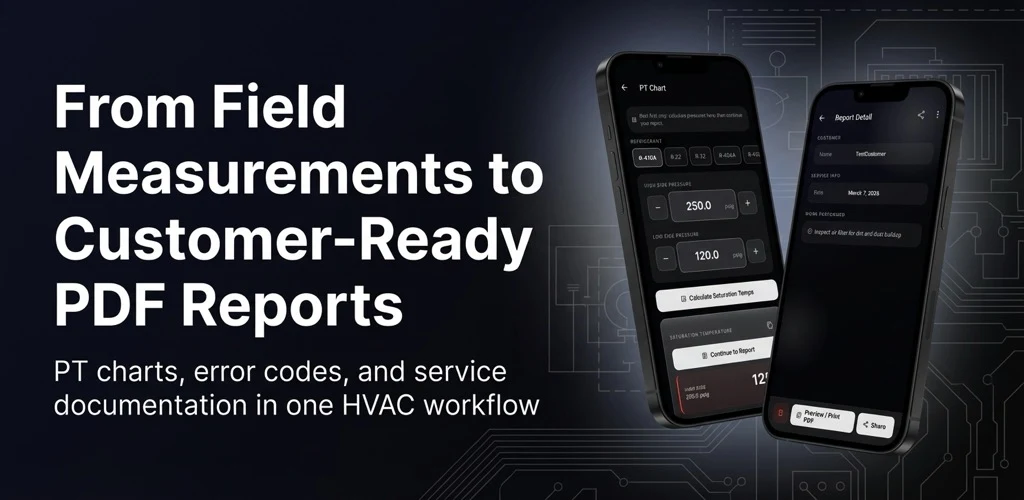
One tool built specifically for this kind of fast, focused field work is RefriPro. Available on Android in English and Korean, it provides PT charts, superheat and subcooling calculators, refrigerant charge tools, duct sizing calculations, and error code references — all in a single app designed to work offline. There are no subscription fees, no account creation requirements, and no unnecessary complexity. It is the kind of tool that respects a technician's time: open it, get your answer, and get back to work.
Whether you choose RefriPro, Danfoss Ref Tools, HVAC Buddy, or any other app, the key is to find one that fits naturally into your workflow and that you can trust to be accurate and available when you need it most.
Putting It All Together: PT Charts in Real-World Diagnostics
A PT chart is not just a lookup table. It is the starting point for a diagnostic thought process. Here is how experienced technicians use PT data to reason through common service scenarios.
Scenario: Low Superheat, Normal Subcooling
If superheat is below 5 degrees F but subcooling is in the normal range (10-15 degrees F), the evaporator is being flooded with more refrigerant than it can evaporate. On a TXV system, this usually points to an overfeeding expansion valve — possibly a stuck-open TXV, an oversized TXV, or incorrect TXV superheat adjustment. The system charge is likely correct since subcooling is normal.
Scenario: High Superheat, Low Subcooling
High superheat (above 20 degrees F) combined with low subcooling (below 5 degrees F) is the classic signature of an undercharged system. There is not enough refrigerant in the circuit to fully flood the evaporator or produce a solid column of liquid in the condenser. Check for leaks, verify the charge, and add refrigerant as needed.
Scenario: High Superheat, High Subcooling
This combination — high superheat with high subcooling — indicates a restriction between the condenser and the evaporator. Refrigerant is backing up in the condenser (raising subcooling) but not getting through to the evaporator (raising superheat). Common causes include a restricted filter-drier, a kinked liquid line, or a partially blocked metering device.
Scenario: Both Pressures Higher Than Expected
If both your suction and discharge pressures are higher than the PT chart suggests they should be for the given conditions, think about heat rejection. The condenser may have restricted airflow — a dirty coil, a failed condenser fan motor, or debris blocking the coil. The system cannot reject heat effectively, so pressures rise across the board. Non-condensables (air) in the system can also cause this pattern.
Building Confidence With PT Charts
Reading a PT chart is one of the first skills taught in HVAC training, but truly understanding and applying it takes years of field experience. The more you use PT data in your daily work — checking superheat on every cooling call, verifying subcooling on every TXV system, comparing your readings against expected values for the specific refrigerant and conditions — the more intuitive it becomes.
Start with the refrigerants you see most often. For most residential technicians, that means knowing R-410A and R-22 pressure-temperature values almost by memory. For commercial and refrigeration techs, add R-134a, R-404A, and increasingly R-32 and R-454B to your working knowledge.
Keep a reliable PT chart reference on your phone — whether it is a dedicated app like RefriPro, a manufacturer tool, or even a saved PDF. The important thing is that it is accessible instantly, works offline, and covers the refrigerants you encounter. A PT chart you cannot reach when you need it is as useful as one you left in the truck.
The HVAC industry is changing fast. New refrigerants are entering the market as high-GWP options are phased down. R-454B is replacing R-410A in new equipment. R-32 is becoming the standard in many parts of the world. Each of these refrigerants has its own pressure-temperature profile, its own operating characteristics, and its own handling requirements. The technicians who stay current with PT data for these new refrigerants — and who have reliable tools to reference that data in the field — are the ones who will adapt and thrive.